Ilish Bhapa, the Taste of a Divided Bengal
For thousands of displaced families forced to leave behind their homes, friends, and lives, recipes became the last remnants of erased identities and vanishing geographies. And amid that rupture, Ilish Bhapa was the one preparation that felt like a truce, finds Roshni Chakraborty.
The only times I have seen my father evade a direct question with the agility of a seasoned politician were the days he bought off-season Hilsa. He would walk in holding pieces of fish cut far too intricately for what he described as an “impulsive purchase,” tucked inside a black plastic bag. His expression was always carefully neutral as he deposited it by the sink and attempted a quick exit — only to be blocked by his wife.
“How much?” my mother would ask immediately.
He would clear his throat. “Reasonable.”
“How reasonable?”
“Market price.”
“That is not an answer.”
What followed was a ritual dance. The unmistakable shriek from my mother once the number was finally revealed; my father launching an admirable defence: how the shopkeeper had sworn it was genuine Padma Ilish. I would sit in the adjacent room, pretending to read whichever school textbook was in front of me that day, while my mind inevitably drifted towards what this argument meant for lunch.
Then, as quickly as it rose, the storm would settle. The fish would be washed. Scales checked. Texture examined. My father and I would creep toward the kitchen doorway, waiting silently for the verdict. And my mother, holding up her hands, would offer a smile so small you might miss it.
“There was a lot of oil while washing the fish.”
The mark of a good Hilsa. And proof that my father had not been ripped off.

Ilish maach or hilsa. Image credit: Wikimedia Commons
Every year, there is always talk about export permissions, fishing limitations in the Padma River, and the diplomatic back-and-forth between Dhaka and Delhi. There are news articles explaining at length how to distinguish real Hilsa from fake ones, shared extensively on the family WhatsApp groups. When Hilsa crosses the border into West Bengal in the long monsoons that inevitably stretch till Durga Puja, they are treated like a ceremonial envoy. The fish is never just fish; it encompassed trade policy, river ecology, national pride, and appetite braided together.
But in home kitchens it is something more intimate: a sign of indulgence.
Growing up in a half-East, half-West Bengali household meant Ilish was less a meal and more a conversation that never quite ended. My mother’s family is from what is now Bangladesh, and my earliest memories of this fish were my grandmother’s childhood stories in which Hilsa was not an extravagance but a rhythm. The Padma gave and the kitchens got busy. A person could eat three to four pieces of fish, all prepared differently, without having to worry about the inflated prices of today. The mustard was always ground fresh, sharp enough to sting the sinuses, then worked into a fragrant gravy. The delicate fish was added only in the final few minutes, simmering gently for barely five minutes before the pot was taken off the stove. Alongside it, there would be one piece fried crisp and another poached simply with nigella seeds, green chillies, and salt — plenty for both lunch and dinner.
Epar bangla or West Bengal, preferred balance. Colonial Calcutta, once the capital of British India, cultivated refinement as identity so the meals were more structured, the gravies were softer, and coconut paste and poppy seeds were used to temper heat. Sweetness was woven gently into savoury dishes because moderation signalled civility, and food had become a language of composure. East Bengal, by contrast, evolved along riverbanks rather than drawing rooms. The boldness in their food came from how they dealt with nature first; an ecological solution rather than a political one. Mustard was in abundance, and with all that humidity, they had to figure out how to keep food from spoiling. So, fermentation and pungency were logical next steps. These sharp differences between two sides of the same land were nothing but practical repercussions of how they evolved, as fish wasn't really a special meal for Bangalis; it was simply what they ate everyday.
Then history intervened.
The famine of 1943 sharpened Bengal’s relationship with food — extravagance became unaffordable and rice sacred. And then the partition in 1947 further tore rivers into borders. Families crossed over with recipes but without homes. Tangy ground up spices and mustard-heavy gravies followed the refugees into Kolkata’s cramped settlements and in those refugee kitchens, pungency became insistence. To keep food sharp was to refuse dilution; of their people and their history. Meanwhile, established West Bengali households guarded their refinement; too much mustard, too many chillies were dismissed as rustic excess.
Yet, despite these fault lines, compromise always found its way to the table. Ilish remained common ground. Both Bengals claimed it fiercely. Bangladesh declared it their national fish, while West Bengal awaited seasonal imports like long-lost kin. Decades of marriages between these two lands led to innovative additions to traditional recipes, both sides bringing forward what they’ve learned for their mixed households.
My mother who finds fish too strong for her taste yet would protect the last piece of Hilsa as her own, always appreciated the way my paternal aunt would fry the fish lightly before putting it in gravies, toning down its fishy smell. But in my maternal grandparents’ house, my father and grandmother would secretly form an alliance of putting the fish raw to steam and in gravies, protecting its fragility, and convincing us with a straight face that they definitely fried it beforehand. My daadi from Epar Bangla taught my mom how to strain black mustard paste with warm water to tone down its pungent taste, while my naani taught me to steam the fish with hung curd, ginger, garlic, onions, and spices for a Mughlai version of the fish she saw on television. Everyone on the dining table had the fish made comfortable for them; this once a year economic activity of buying Hilsa, indulged in with much pleasure and the nitpicking of each other’s cuisines softened into jokes enjoyed over second helpings of rice.
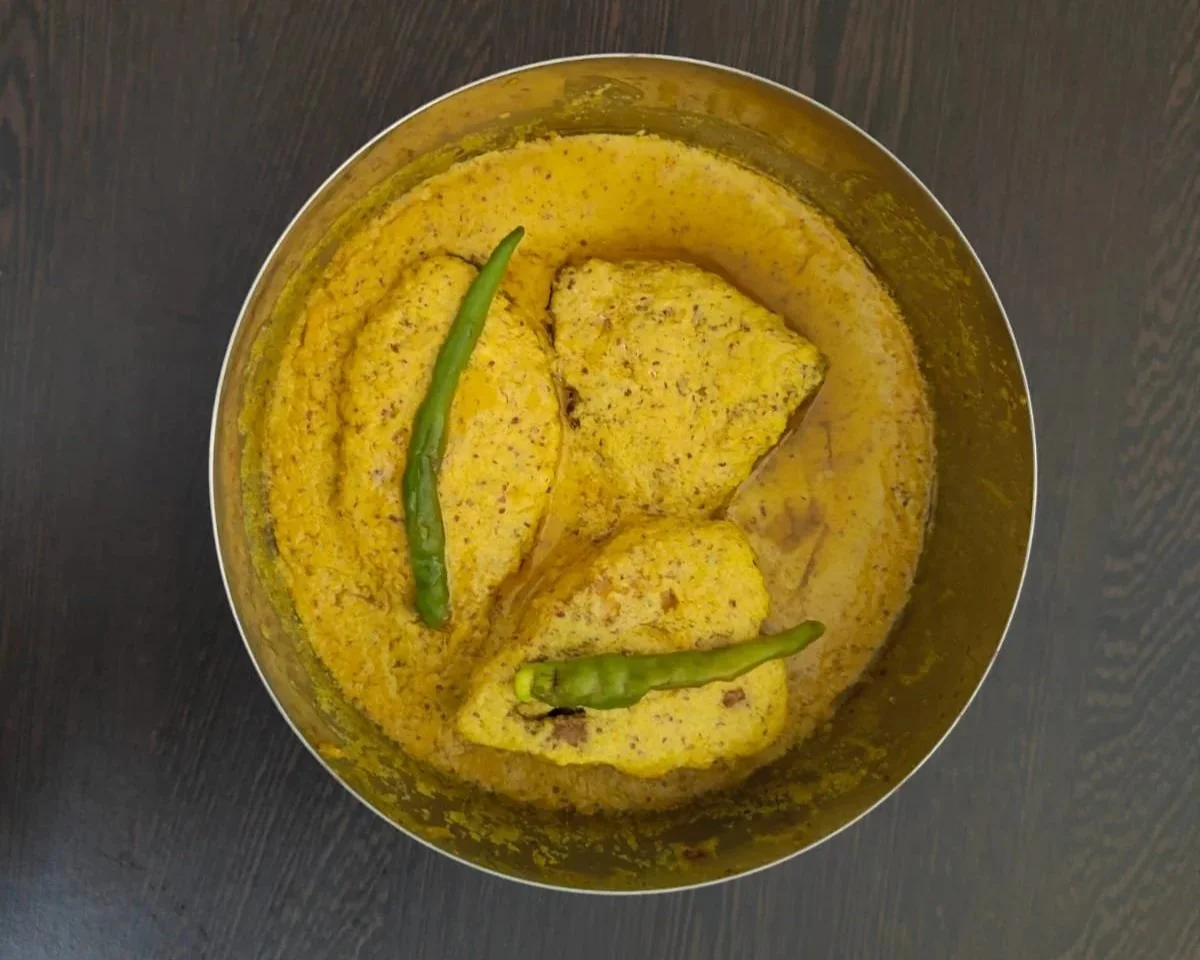
Before time could soften the blow endured by thousands of displaced families forced to leave behind their homes, friends, and entire lives, their recipes became the last remnants of erased identities and vanishing geographies. Amid that loss, Ilish Bhapa—hilsa steamed with mustard, curd, and coconut milk—was the one preparation that seemed to offer a truce.
In it, the fish is coated, sealed, and left alone. It cooks in its own oil, its own history. No stirring; no disturbance. Bhapa carries East Bengal’s mustard-forward confidence but absorbs West Bengal’s gentleness. It survives adaptation: banana leaves replaced by steel tiffin boxes, sil-batta replaced by mixer grinder, and riverbank fires replaced by stainless steel pans.
It is perhaps the most forgiving way to taste a history that was anything but forgiving.
I ate Ilish in countless forms growing up — paturi wrapped carefully in banana leaves, jhal rich with mustard oil and spice, bhaja eaten with hot rice and fingers slick with oil. But when I left home for the first time, it was bhapa I chose to cook.
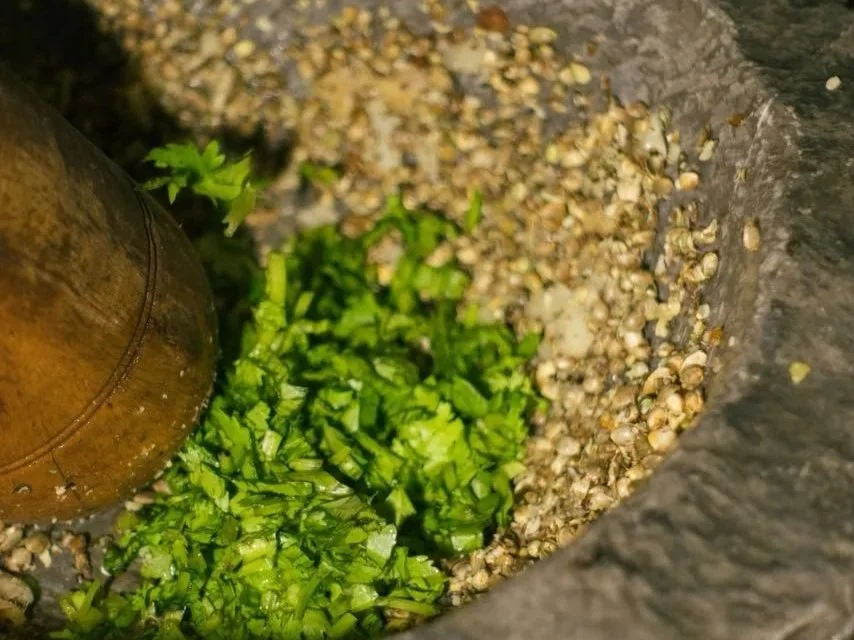
I ground mustard too quickly the first time; it turned faintly bitter. I called my mother. “Soak it first,” she said. “Strain it. And always salt before steaming.”
“But the paste still tastes too pungent.”
My father would then assure me how the heat of steaming will soften the pungent taste of the mustard paste.
The cooking left me speechless at how easy it was; the meal almost cooked itself. Hilsa, also known as the queen of fish in both Bengals, didn't need any ornamentation to maintain its royal status. And standing there watching steam cloud the lid of a makeshift pot, I realised that ilish bhapa was not simply the easier preparation but the one recipe that carried both sides of me without tension. It carried famine’s caution, colonial refinement, refugee stubbornness, modern diplomacy. And all it asked for, was a little patience.
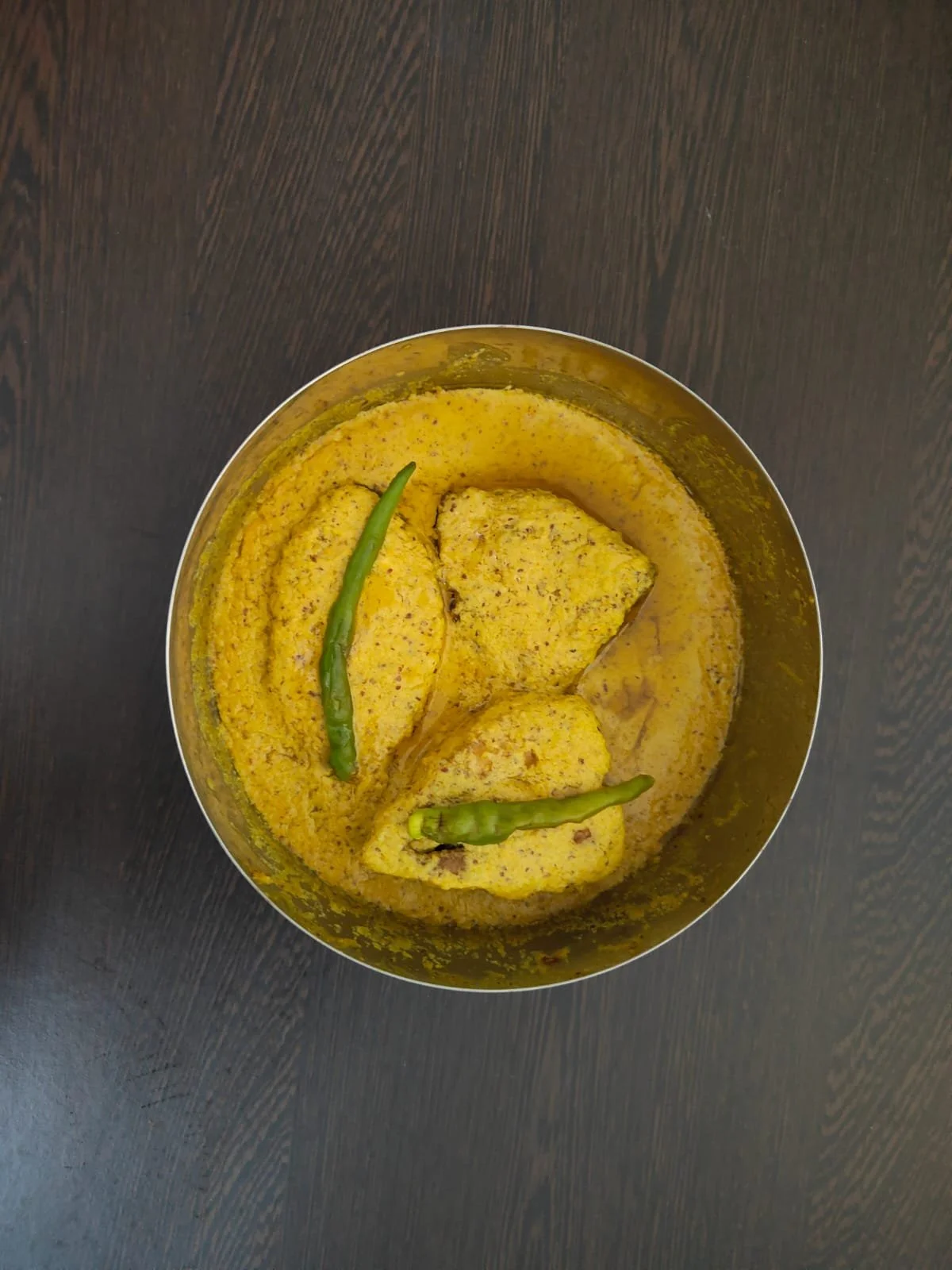
On lifting the lid the smell was immediate — sharp mustard, mild coconut, warm oil and green chilli rising into the air. I plated it carefully, aware of the price, aware of the politics, and also aware that somewhere across the border, the same fish was being steamed under a different flag.
Some things in Bengal are understood without being articulated. The weight of migration, the cost of rebellion, and the taste of history. They linger in the slightly pungent aftertaste of mustard.
RECIPE FOR ILISH BHAPA
Serves: 3 people
Time Taken: 40 minutes (with minimal effort!)
Ingredients
3 pieces of bellycut Hilsa fish (without roe)
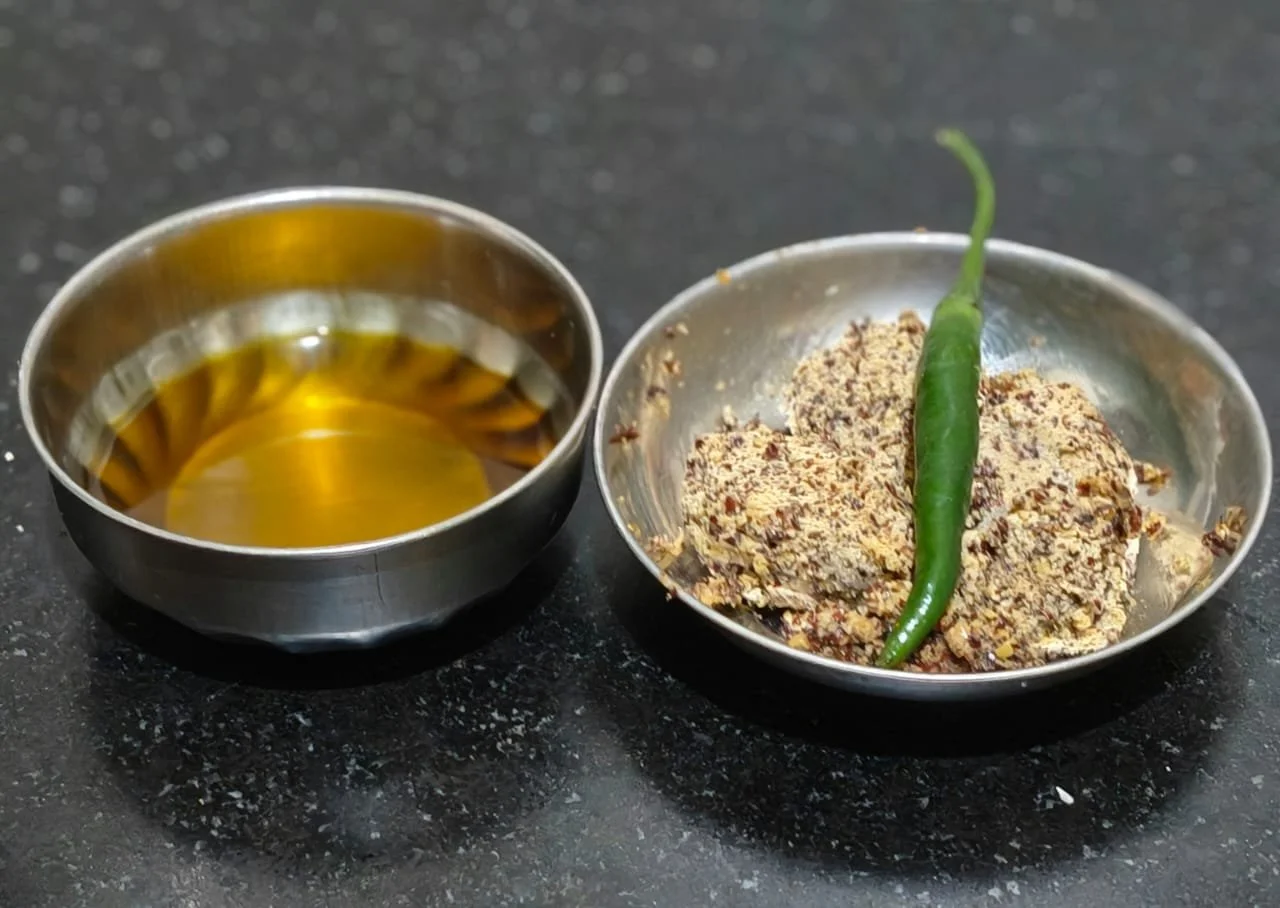
40 g black+yellow mustard seeds
2 piece green chillies
Salt to taste
Water as required
50 g coconut milk powder (you can also substitute this with fresh coconut while making the mustard paste)
1 tbsp yoghurt (beat until uniform)
20 g mustard oil
1 tsp turmeric powder
Method
Soak the mustard seeds in warm water and salt for removing the bitterness. Keep it aside for 15 minutes, then strain and grind it into a fine smooth paste along with salt and green chillies.
In a steel tiffin box with a tight fitting lid, add the mustard paste.
Add the coconut milk powder, yoghurt, turmeric powder, mustard oil, and add salt if needed.
Mix it well, and then put the fish pieces in the box, coating each of them evenly with the mustard paste.
Slit 2 green chillis into halves and put one half over each fish.
Allow the fish to marinate for 15 minutes
Take a large saucepan, and put a stand inside it. Place the tiffin box with its lid tightly shut, and pour hot water into the saucepan, making sure it does not reach above half the height of the container or the water can seep in.
Let the water boil, then cover the saucepan and keep the flame on medium heat for 15 minutes. (You can use a fork to check post the 10-12 minute mark if the fish is cooked, to prevent overcooking).
After it’s done, take out the tiffin box, and keep i aside to rest for 5-10 minutes.
Serve with piping hot rice.
Roshni Chakraborty loves books, history, and food with great passion, also works in data science quite professionally.
ALSO ON GOYA