Traditions, Trekking and Taste: Foraging in Cambodia
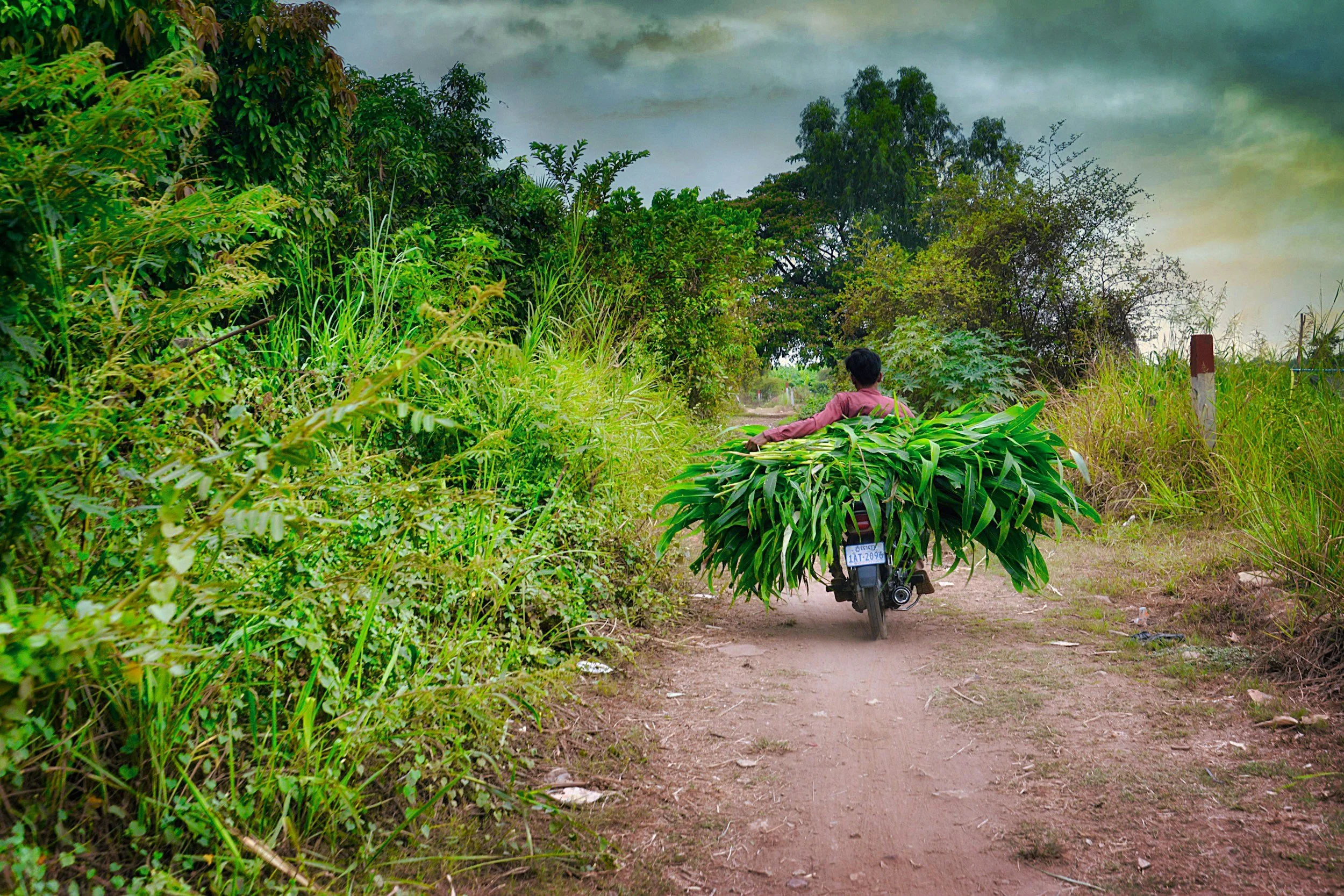
Across Cambodia’s ecosystems, foragers gather wild food plants, from bitter neem leaves and sweet potato leaves to bamboo shoots. Foraging is part of everyday eating in Khmer cuisine, finds Muneezay Jaffery, where the wild food plants are central to diet diversity, traditions and feeling satiated.
Consider the salad leaf, rocket/ arugula (Eruca Sativa) and its taste: peppery, pungent, bold, perhaps even a little juicy. Now consider its place in our kitchens: within salads, cheesy tarts, pizzas, and pesto. Pre-social media, it made its way to us through trendy restaurants, cookbooks, and food blogs. However, all fail to mention that fancy arugula is also a roadside weed native to the Mediterranean and Asia. Though known for its edible (and more colourful) properties since Roman times, the story of rocket/arugula demonstrates how edible plants move from ‘wild’ to ‘cultivated’ and again to ‘desirable’ and ‘palatable’ across history, places, and popularity.
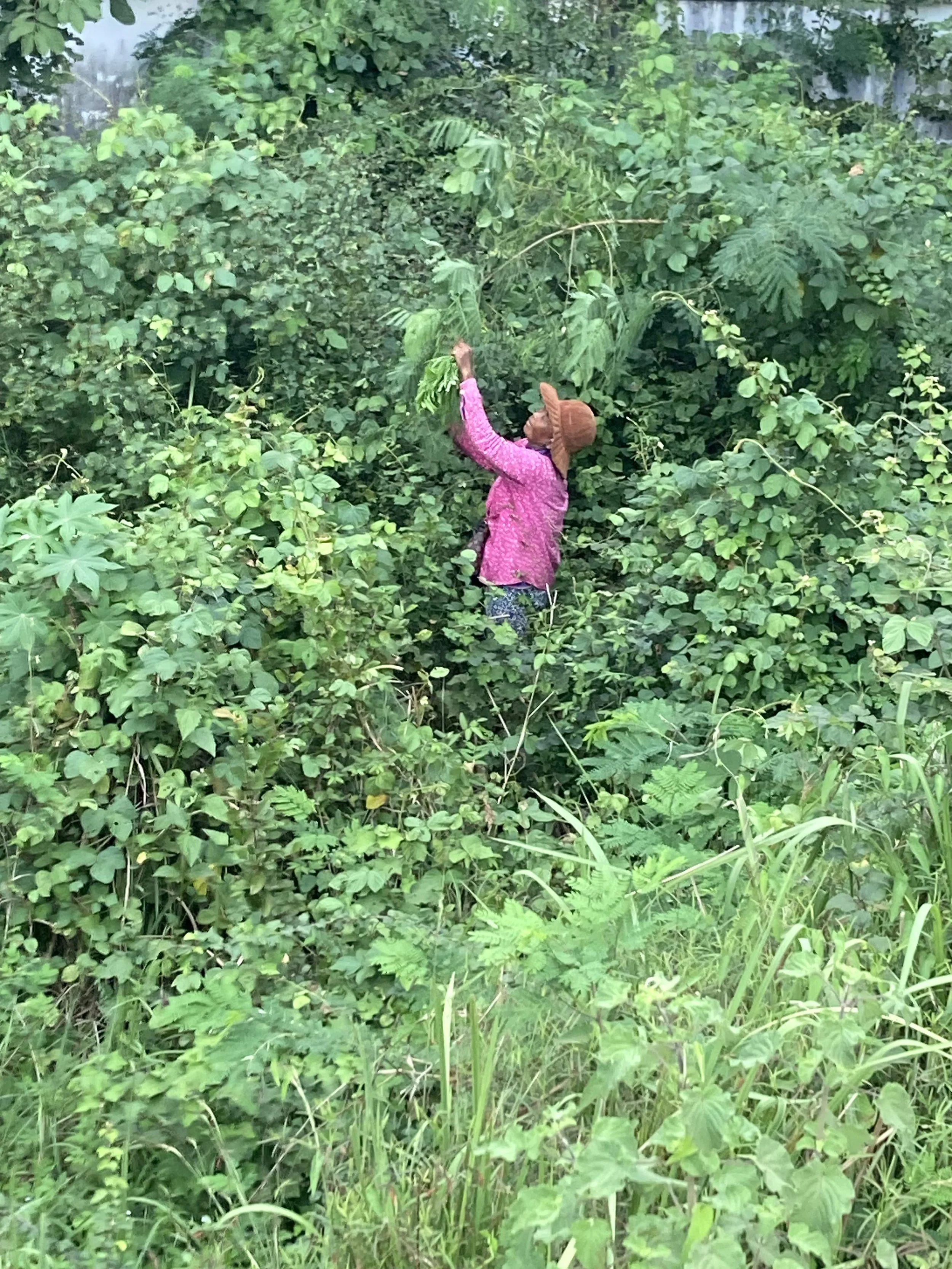
Before researching wild food plants in Cambodia, I was pleasantly surprised and immediately conscious of my ignorance of how imbued foraged plants are in Khmer cuisine, particularly in the rural areas where I spent most of my time. Experiencing a new culture can sometimes mean taking it all in at once and not realising the uniqueness or exceptionality of flowers as an ingredient at a noodle stall, or undistinguishable leaves accompanying a street-side order of ban chao (Cambodian Crepe). Thinking back to visiting families in the village or our own staff plucking leaves — usually tart and astringent tasting — to eat with fried fish, I began to wonder if this was the exception or the norm?
Many readers would consider foraging and consuming foraged foods to be: trendy, lifestyle choice, or perhaps a conscious act to connect with nature. However, for many communities around the world, it is an everyday act. From herbs chosen at the market, to picking leaves within their vicinity to traveling 40 kilometres because a particular fungi or plant is in season, foraging is part of everyday eating. This is very much true for Cambodia, regardless of location — foraged plants are everywhere. What varies are the abundance, likelihood, and diversity of foraged plants in different settings — and of course, the Traditional Ecological Knowledge (TEK) which surrounds them.
Most TEK is embedded within local communities and orally passed down, carrying with it deep connections with natural environments through rooted long-term observations. In an age of fast-moving information and long-standing cultural perspective hegemonies, there are threats and fears that TEK may be lost. However, how we choose to eat and consciously recreate foods that offer comfort and or invoke memories are important ways to uphold TEK.
In the province of Oddar Meanchey in the northwest of Cambodia, 48 kilometres from the Thai Border, is the town of Samraong. Like any other Cambodian provincial town, it is small, primarily agrarian, with a bustling marketplace surrounded by rice paddies. There are no traffic lights yet. Those living in Samraong would consider it urban, whilst those in the capital city of Phnom Penh would consider it in the countryside and rural. Cycling down the backstreet of the main marketplace in the early morning, here are flowers (water hyacinth), buds, cucurbits, various leaves (sweet potato and piper betel), and (bamboo) shoots. Along country roads, a flash of pink among the overgrowth signals to a lady in a hat foraging edible leaves, her motorbike parked nearby and overflowing with collected edibles.
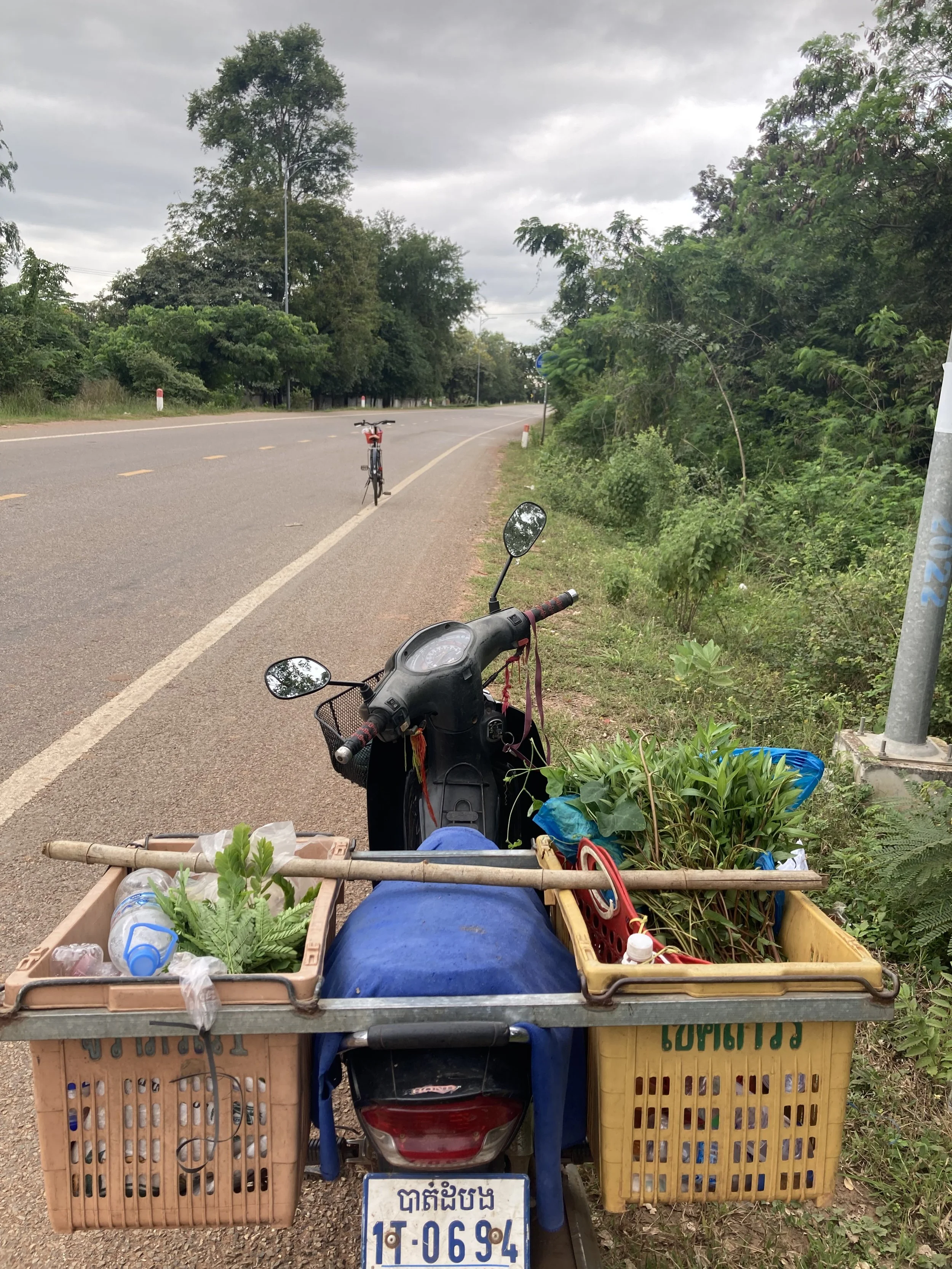
In many rural towns, it is common to see merchants on stools with a skirt of edible plants around them.
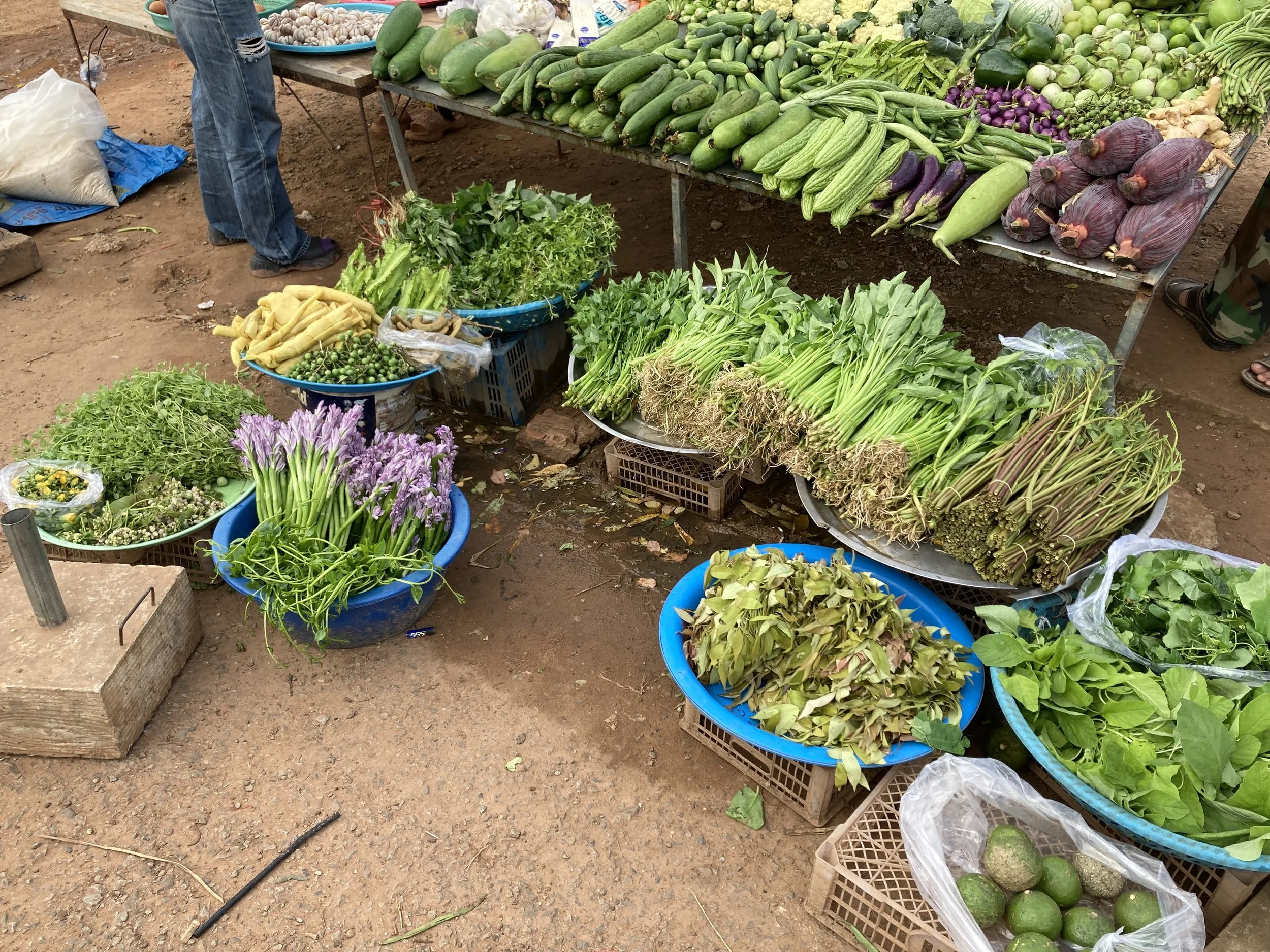
Foraging is part of everyday eating in Cambodia.
This raises genuine questions: “what is foraged?” and “what is wild?” We will keep it simple: foraged plants are edible plants (or fungi) that are uncultivated (i.e. not planted with intention), but purposefully picked. They tend to be eaten immediately, taken home to be cooked, preserved or served at a restaurant, or directly sold in markets. The latter categorisation is perhaps contested because consuming foraged foods is often directly linked to the physical labour and toil of foraging. However, shifting the focus to taste, cravings, knowledge and knowing (how to consume) broadens the definitions and highlights local foodways. Consuming wild food plants (WFP) showcases dietary diversity and ecological preservation while keeping TEK exchanges alive.
By noticing and unravelling the layers of these everyday practices, the symbiotic relationship between WFP consumers and their environment emerges. In Samraong, it is knowing what is in season, where the best foraging locations are, what is available nearby, and how plants can be prepared or consumed.
It would be amiss to discuss foraging without mentioning land access and laws. The most common foraging locations include: land surrounding homes and family rice paddies during the rainy season. Traditional rice growing requires farmers to visit their rice paddy on a near-daily basis, especially during the early months. People also forage in community forests. In the 1990s as Cambodia edged towards normalcy and reconciled land management systems destroyed by the Khmer Rouge (who abolished all private land ownership), community forests emerged as a post-conflict mechanism that allowed local control on natural resources and rebuilt rural areas. There are nearly 636 community protected forests in Cambodia. However, the extent to which they manage to protect forests is skewed, as on the whole, Cambodia exhibits one of the highest rates of deforestation. In the last 25 years, illegal logging, economic land concessions, and agrarian expansion for monocropping has reduced forest cover by 33%.
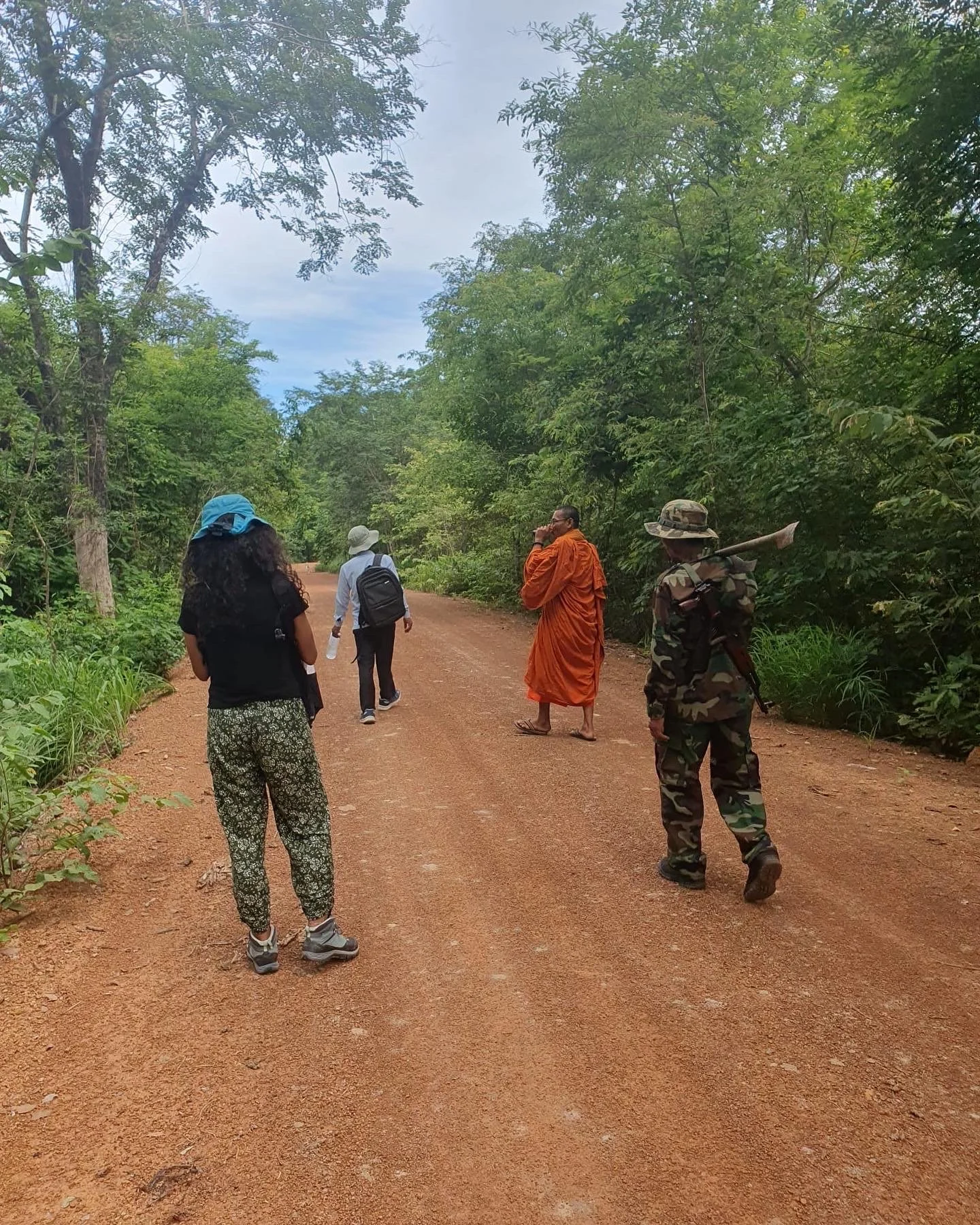
The Monk Community Forest in Oddar Meanchey is a forested area protected by Monks and members of the army.
The Monk Community Forest in Oddar Meanchey is one such space, carved out in 2001 when the province was formed. Starting out with nearly 45,000 Ha of protected land, the forested area protected by Monks and members of the army, stands at 18,000 Ha. As you enter, large old trees ordained by monks tower around. Here, there is a unique effort in protecting the forest whilst still promoting non-timber forest products (NTFP). Approximately 1% of the forest has been made easily accessible for the purpose of accessing NTFP (these include honey, foraged plants, fallen timber for firewood, fruits and fungi).
Despite the diametric presence of monks and armed soldiers doing their routine patrolling, there are often mentions of illegal loggers or poachers. Given the distance, the Monk Community Forest is seen as a superior and (dependable) foraging location for prized mushrooms or edible flowers during the rainy season). People often go in groups with their neighbours or family members— to not only obtain a large haul with certainty (to sell onwards), but also in a bid to pass on this knowledge to younger family members.
Superseding the conventional oral ways to transfer knowledge, there is also a vibrant online community of vloggers and mukbang creators that fuse countryside aesthetic with plant-knowledge, food preparation that focuses extensively on taste, describing how it feels: “sour/sweet, delicious — try it with chili or chili salt”. We can see the baton of TEK is being not only passed on through content creators, but exchanges via the digital scape allows WFP foragers and consumers to surpass regional differences and invoke adaptability to climate change through highlighting the edibility of various plants which may be seldom found.
The most surefire way a wild food plant haul is enjoyed is through mahop anloth, or a complete meal compromising a raw platter paired with a dip and bowl or rice. Plants are prepped as per needed; some are blanched to make them more palatable, “remove bitterness” is a common explanation. Others are arranged raw, as collected. None of them are seasoned (i.e. no salt, or pepper)- but served with dips central to Khmer cuisine- that vary by region.
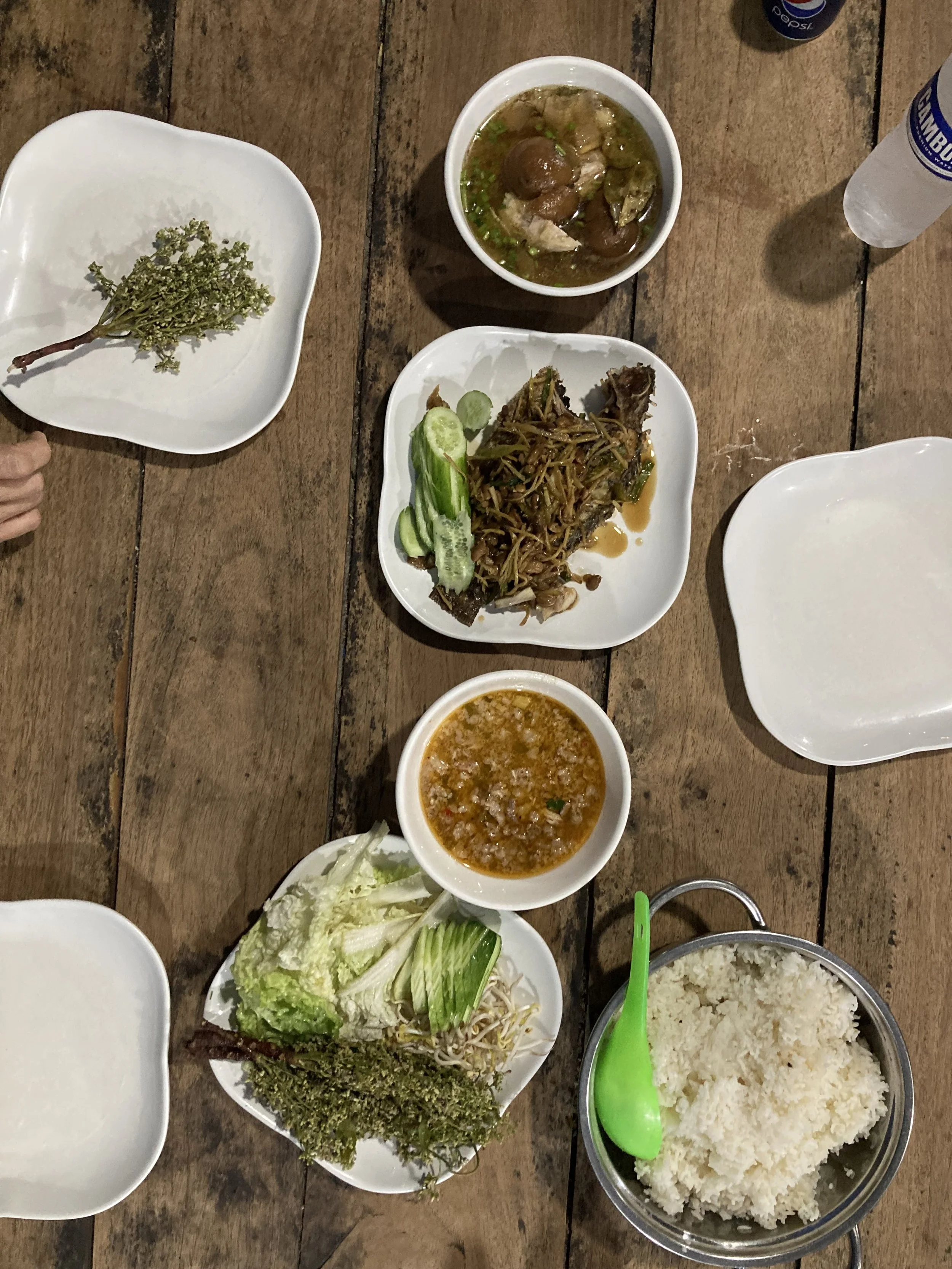
The most surefire way a wild food plant haul is enjoyed is through mahop anloth, or a complete meal compromising a raw platter paired with a dip and bowl or rice.
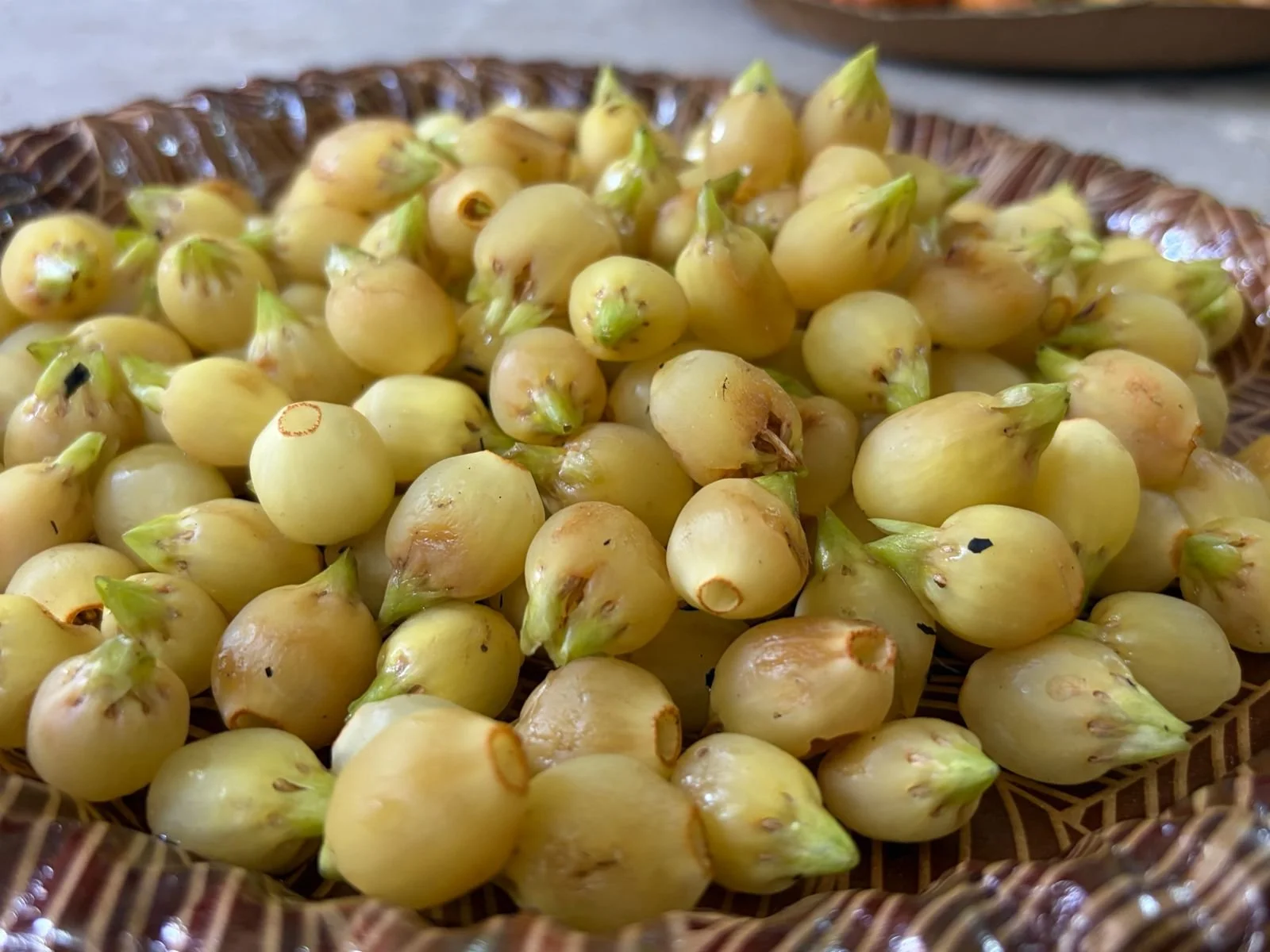
Plants available all year round include Azadirachta indica (neem) for which the edible part is usually the young soft leaves. These are prepared by quickly blanching them in hot water and served with dips made using fermented fish paste. The young leaves along with flower buds (dry season) can be used to make a salad with shredded chicken. The leaves are bitter and slightly astringent which results in a deep flavour that lingers in the mouth. Another vibrantly coloured addition to platters are the soft, purple flowers of Pontederia crassipes (water hyacinth) procured from water bodies such as ponds and lakes. Young, almost budding flowers are considered edible parts, ideally sourced from clean water bodies. The flowers are enjoyed as a salad, as a topping for noodle soups or in sour fish soups. Lastly, an unusual, and often surprising, edible plant is Calamus Salicifolius (Rattan). During the dry season, the unripe fruits have a sharp acidic tase and are enjoyed as a snack with chili and salt. While the inner part of young stalks (hearts of palm) makes an appearance on salad platters or salad leaves. Once prepared, the texture is not uncommon to unripe jackfruit, stringy yet tender.
From the brief descriptions above and thinking back to other wild food plants, one thing is undeniable; there is a certain uniqueness when it comes to taste and texture. Many can be described as mild in taste — i.e. being vehicle for flavour for pungent dips whereas others bring strong, lingering flavours — be it bitter, sour or astringent that work in harmony with the same dips. When foragers are asked if they would transplant or have attempted to transplant any WFP at home to make picking easier — it is met with disapproval. Suggesting almost that it is the unkempt ecosystem and naturally found companionships (also known as inter-species relationships) that allow these plants to thrive, survive and taste how they do.
From a taste-based standpoint one can argue what exactly “natural” or “wild” tastes like. However, it is clear along the spectrum of tastes the deeper/ bitter/ astringent or sharp tastes and pungency of foraged leaves and flowers is what people crave and know how to use best.
Which brings us back to the still-trendy, mildly peppery rocket leaf. A mainstay in global diets is just in actuality just an ancient, wild, foraged plant that keeps its wild side intact.
*Forage safely! Please eat only known plants and fungi.
Muneezay Jaffery works for Green Shoots Foundation an NGO working on environmental education and agriculture particularly among youth in Cambodia.
This article is informed through their project Plant Planet Plate and input from Cambodian food vloggers such as Rural Life Nhet.
ALSO ON GOYA