Padayal: A Tamil Ritual Feast Honouring the Ancestors
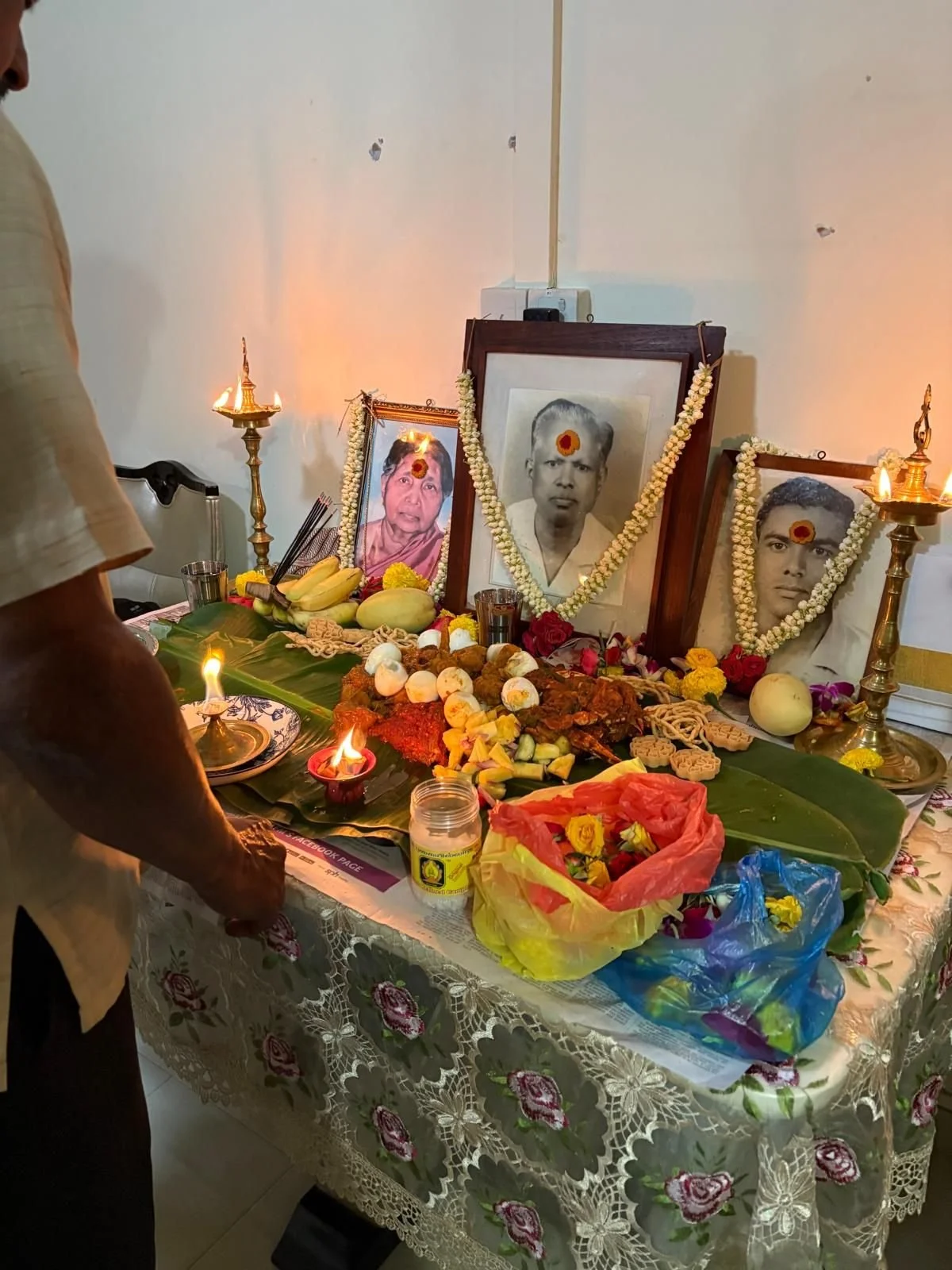
In the Tamil community, padayal is a ritual feast honouring the ancestors though their favourite foods. Arathi Devandran looks at her Singaporean Tamil family’s padayal celebrations as a way of honouring the lives of her family memebers who navigated the opportunities and challenges of modernisation in a new land while keeping the rituals of their forefathers, and creating new traditions.
The banana leaf is laid out.
Meticulously, the aunties bring together the different dishes, which they place around the leaf. My mother is seated on the floor, awkwardly, because she has a metal rod in her knee, and sitting on the floor has been difficult since her surgery.
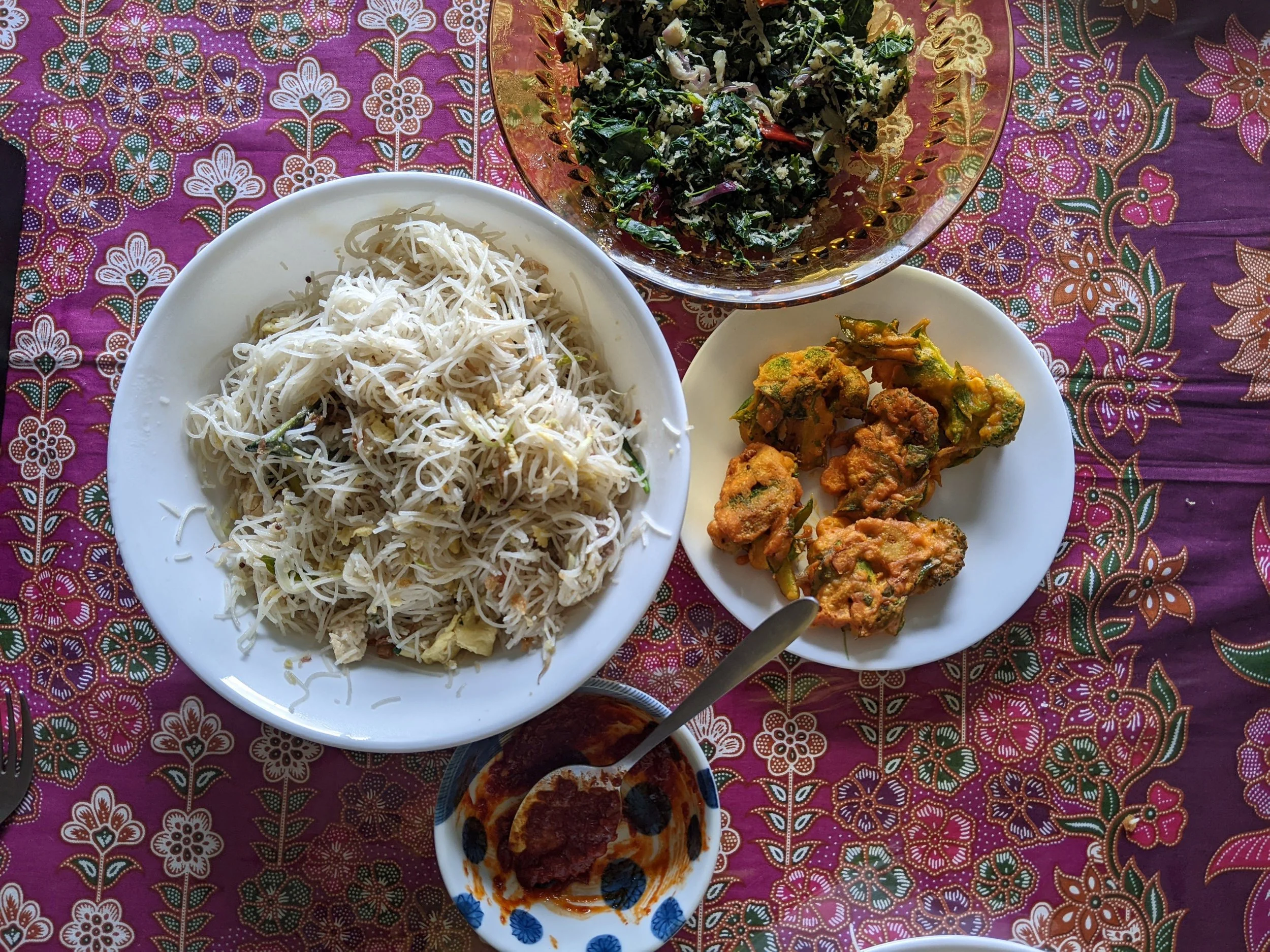
First, she scoops out the rice, spoonfuls of fluffy basmati, filling the middle of the leaf. Then, she starts with the meats. The chicken curry goes on top of the rice. On the sides are laid a dark, and spicy mutton varuval, sotong perattal — round cuttlefish cooked in a tomato base till dry, a meenu sambal — pomfret basted in a chilli paste with ground lemongrass and lemon leaves, and kodalu — an unlikely favourite among the family because most of us do not eat tripe except when it is cooked in this way, like a stew with potatoes. On the other side, the vegetables: cabbage kootu (cooked with toor dal), thousamalli keerai with thengai and nethilli (drumstick with grated coconut and dried anchovies), cucumber achaar, seeni maangai (raw mango cooked down with sugar, salt, and chilli powder until it softens and sweetens), raita and fresh pineapples. Another aunty brings the boiled eggs and lines them around the rice, like a fort.
The banana leaf is full now, but they are not done. In one corner, another aunt arranges the murruku, laddoos, the nei urundais (gramflour laddoos) my grandmother has lovingly made.
My uncle pours out the stout into glass jars and places them in front of the pictures. The agarbathi is burning, the vizhakkus (brass lamps) have been lit.
It is time for the padayal to begin.
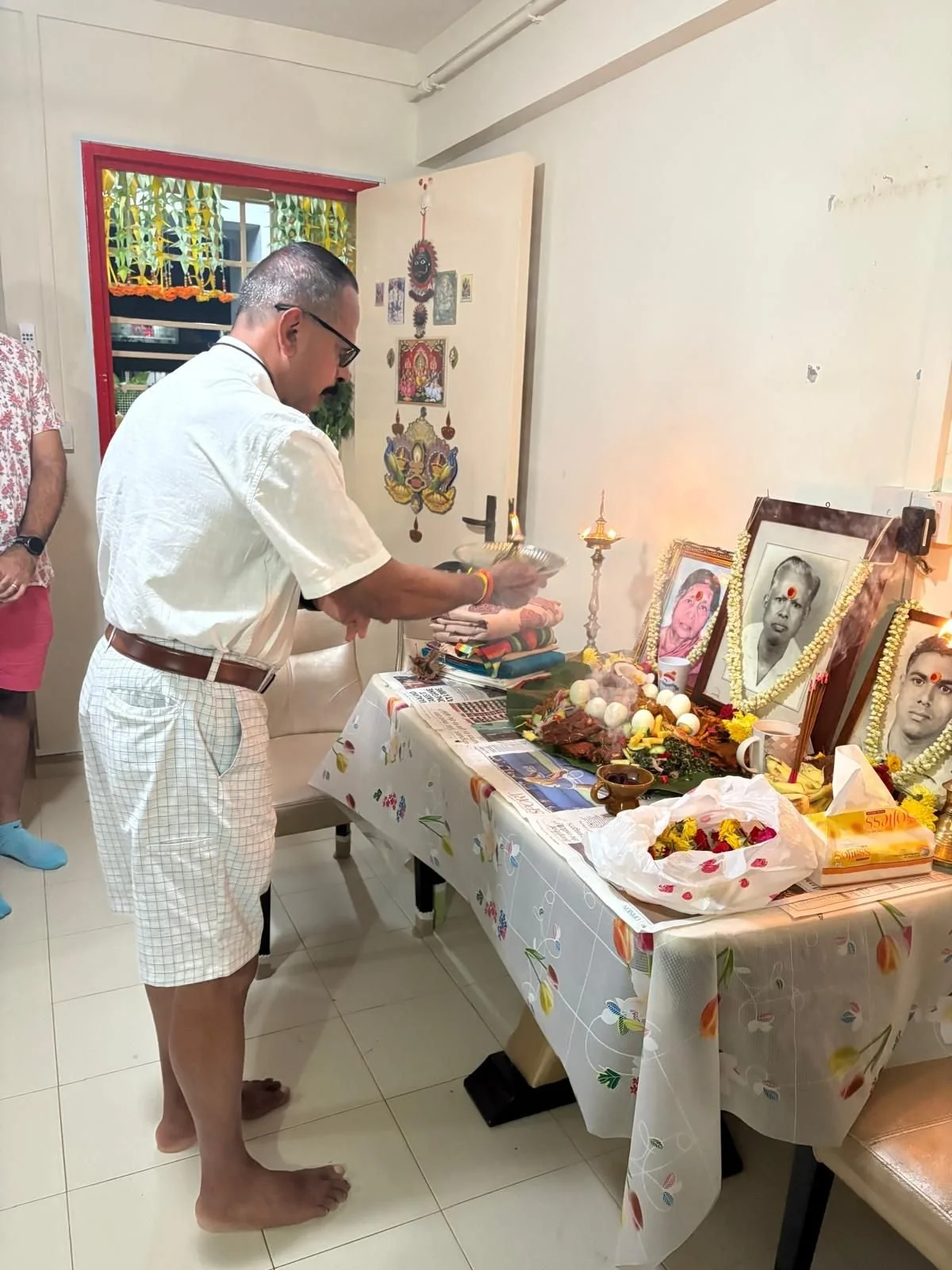
All of us, spanning across four generations, gather around the pictures of my grandfather and eldest uncle. My uncle starts the prayer first, then each of us take our turn, all 30 of us. My grandmother prays last, lingering longer in front of the picture of her husband. She does not say anything, she never does. She returns to her seat, and the conversations among us start up again.
By now, it is late, the skies have darkened. Once the prayers are complete, we wait.
The ancestors must eat first. After that, my uncle will mix all the dishes on the banana leaf, roll them into balls, and give them to us to eat. And what a feast it will be, all those beautiful flavours coming together, sharpened by the hunger in our stomachs. We have waited all day for this meal.
My grandmother watches over us, barely eating. She says that cooking for the family fills her more than food ever will.
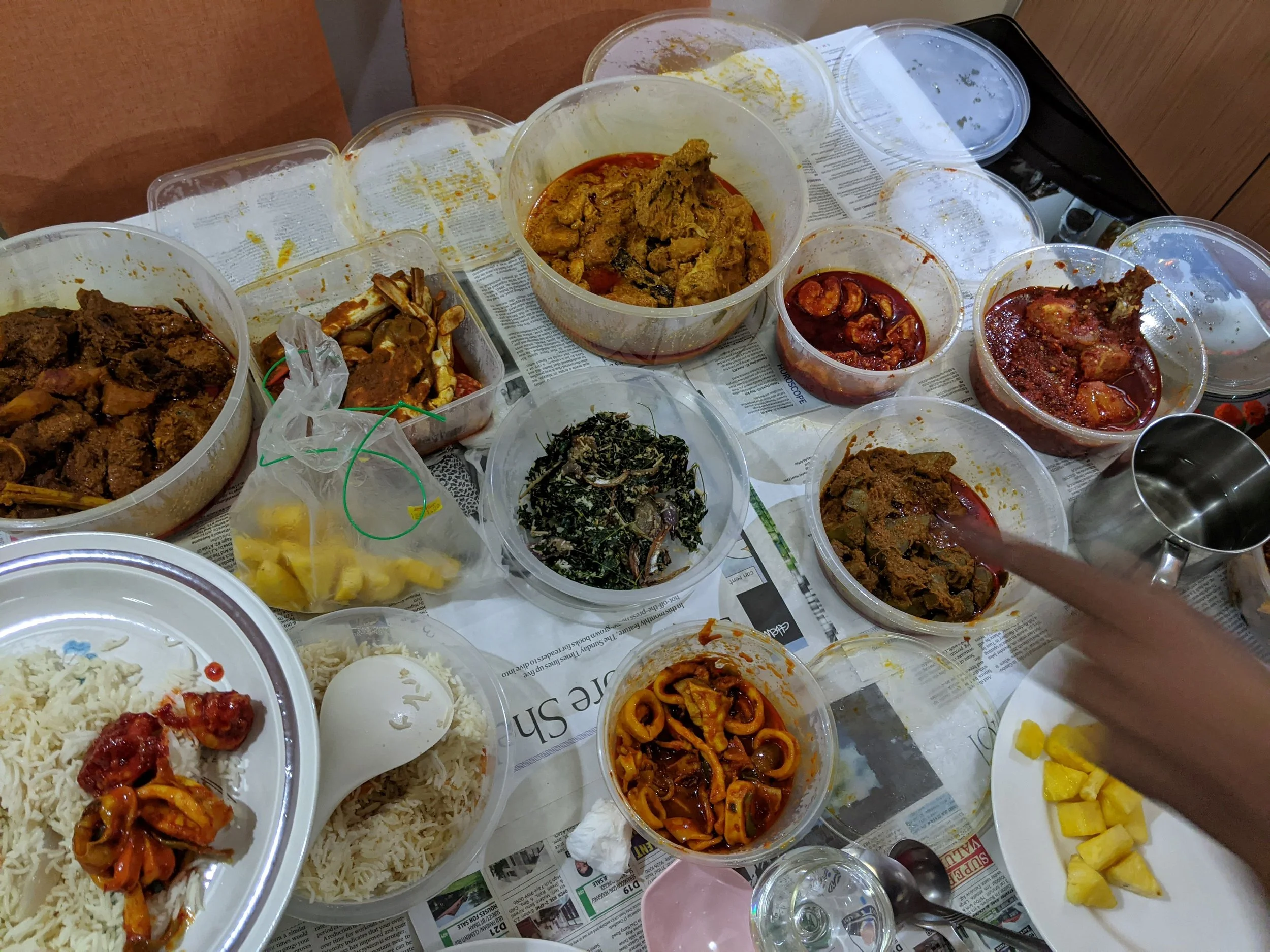
The food brought for padayal.
First, the feast is offered to the ancestors.
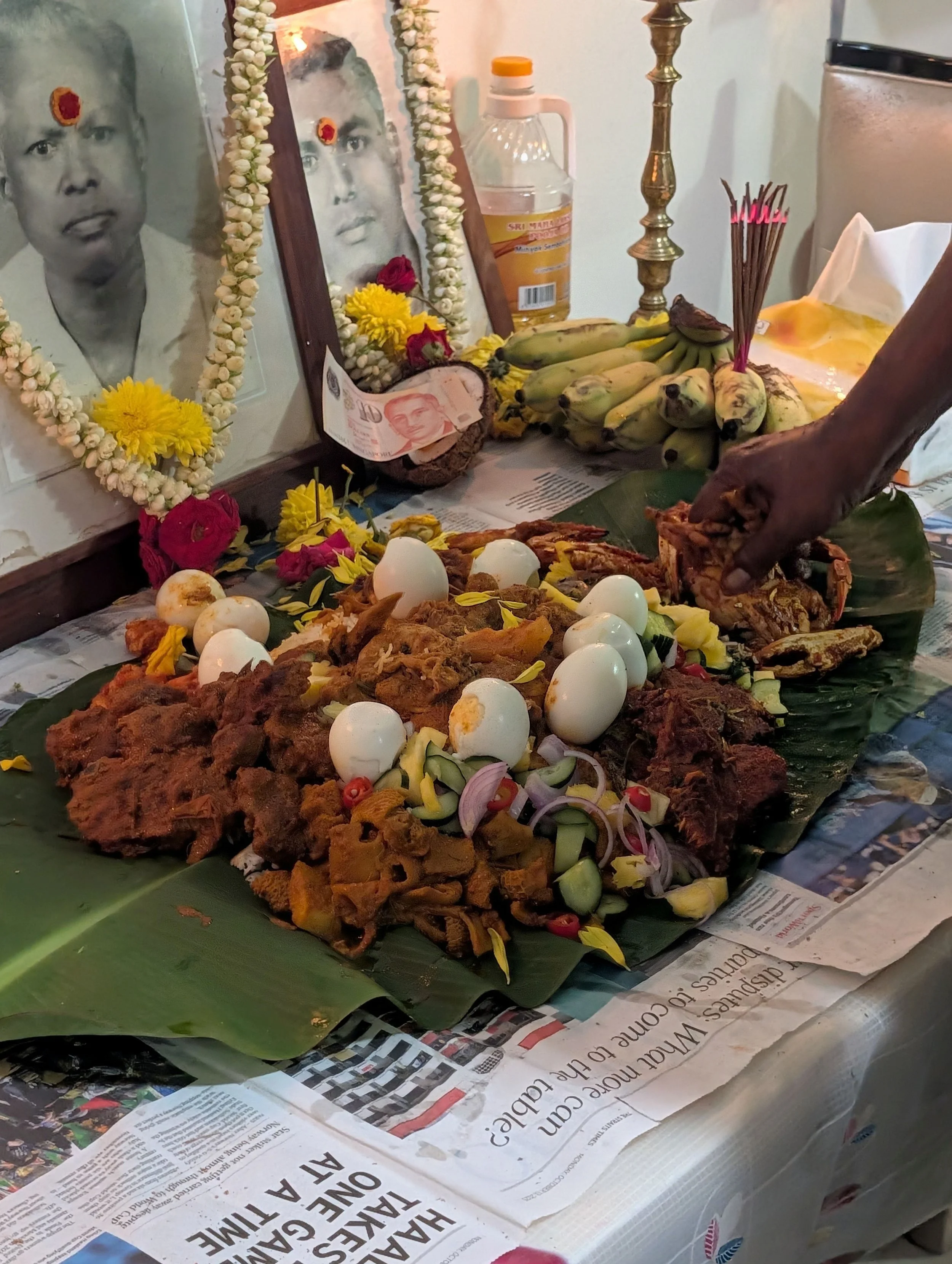
The offering is mixed and served to the gathering.
The padayal is a ritual practised by many Tamil families in Singapore. The dishes vary, the dates in which the padayal is presented to us differs from family to family, though it’s usually within a week of Deepavali. There are other side rituals that come with feeding the dead — honouring their lives by visiting graves at the cemetery, prayers at the temple, gatherings at home.
Padayal is primarily a Tamil practice, which seems to be a synthesis of the ancient instinct to feed the dead (pre-Vedic), shaped by the Vedic ritual calendar and cosmology. The word paṭaiyal itself comes from paṭai (a Tamil word) meaning to offer or present. What makes the padayal distinct from broader Hindu ancestor rituals like shraddha or tharpanam is the emphasis on cooking specifically what the deceased people enjoyed eating.
Though I have never met my grandfather, great-aunt and uncle, all of whom died before I was born, the ritual of the padayal, so familiar, makes me feel like I am close to them. This annual gathering is a time when we remind each other that we are kin, that they have been keeping a watch over me in their own way.
Food, as a celebration of lives lived, a way of honouring.
But wait, my uncle is calling us over now. It is time to feast.
A Cuisine Shaped by Necessity
I come from a family of immigrants. My grandfather arrived in Singapore on a ship from Pudhukottai. He had two wives before, both who died within early years of their marriage. He met my grandmother, who was born in Singapore, when she was 14. It was an arranged marriage, but one, I hear that never was lacking in love, joy or food.
My grandparents were poor. My grandfather worked for the British Royal Navy as an overseer; what little he earned had to feed 10 mouths, most of them young and hungry. My grandmother became innovative with the things she would cook for the family. One can of sardines would be embellished with lots of root vegetables and turned into a flavourful sardine sambal, served with porridge. One fistful of paruppu would become a tasty kadaiyal that would be served with rice and thinly sliced onions. Kanji or porridge was watered down many times over to fill all the children’s bowls.
When I try to describe these decades-old dishes to my friends from other communities, I struggle.
How do I explain that so much of the Tamil food I am familiar with is so specific to my family’s humble origins? How do I break it down that Indian food is not a homogenous classification, that different communities have different ways of interpreting the role of rice in their meals, how a varuval for the Tamilian is different from the ularth for the Malayalee, and how there are at least 10 different types of rotis? How do I explain to my South-Asian friends the ways in which local Singaporean-Tamils adapted their dishes to suit their own destitute existence, and that ingredients had to be stretched and dishes had to become innovative. It meant borrowing tastes and palates from other communities, especially at a time when communities were so porous in kampungs. It meant losing parts of the identity that our forefathers came to this country with, for the survival and success of the communal whole.
How do I explain that when I am talking about South-Asian food, I am actually talking about the socio-economic struggles and evolution of my people through the years, and the ways in which we have tried to carve a niche for ourselves that is quite unlike many other South-Asian communities around the world?
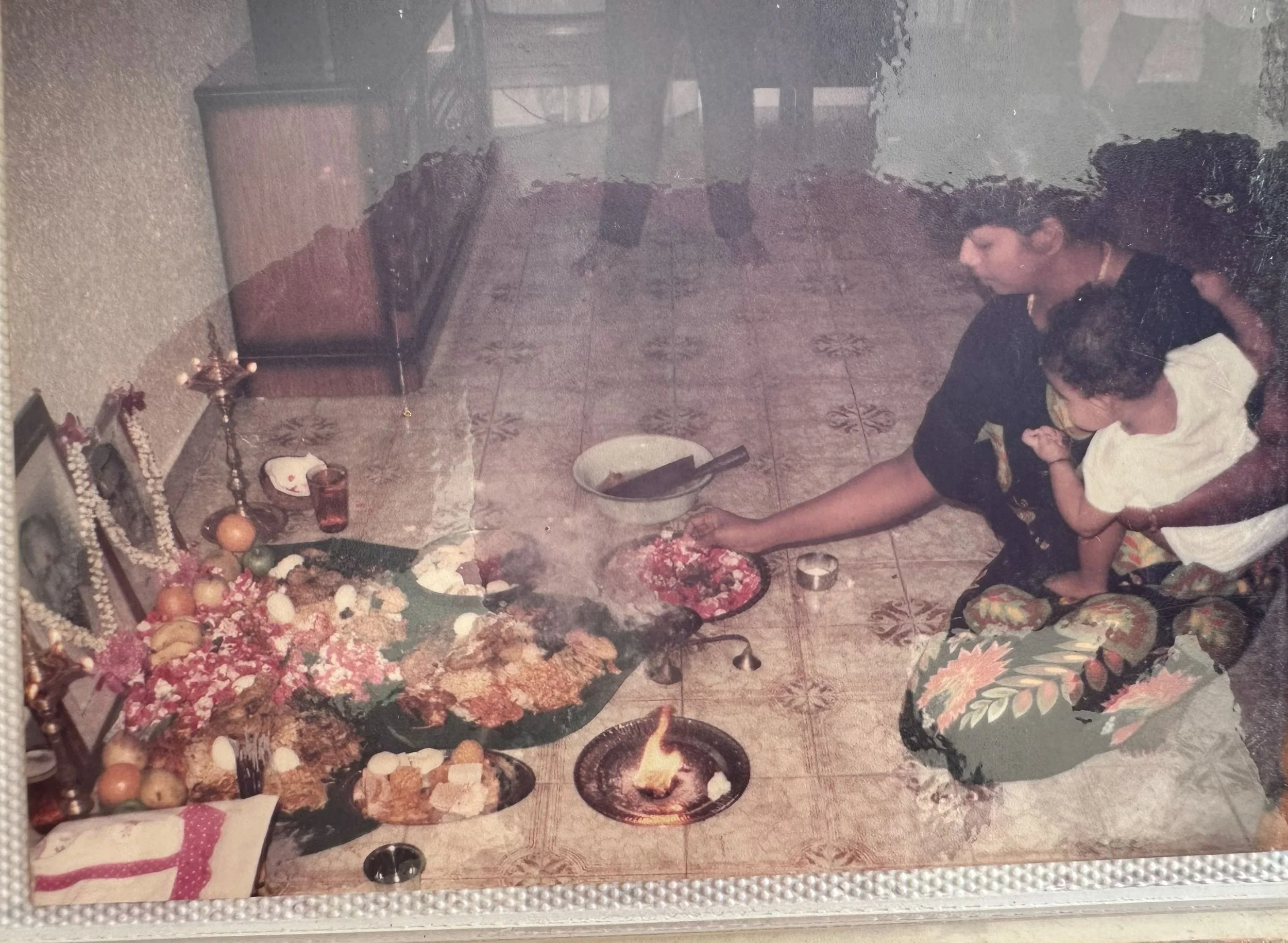
Padayal in the 90’s, with the author as a child.
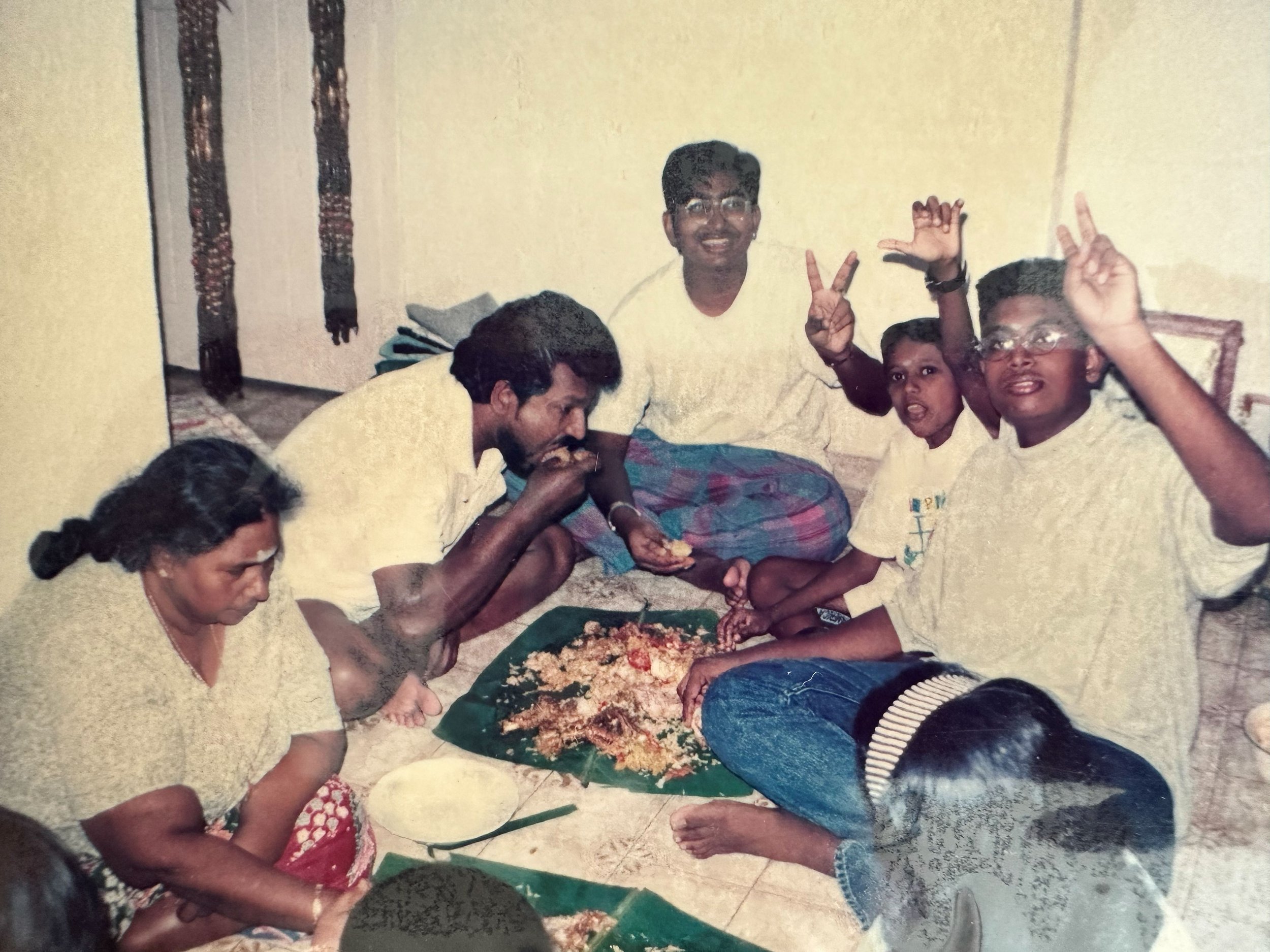
Padayal in the 90s.
I struggle to find these words, so instead, I talk about the role that food plays in my life. I talk about what it means to have ‘Indian’ meals — the laughter, eating with hands, the generosity of family. I talk about flavours and spices and correct misconceptions — ‘Sis, chai means tea, so chai tea is actually a misnomer’. I talk of my personal project of preserving my family’s recipes as a way of preserving my family’s legacy. I talk about food as comfort, as love.
In a myriad of ways, I say, ‘there is history in a dish: that of a country, a family, and a person’.
A Feast for My Grandmother
It is my grandmother’s first death anniversary. I have just returned to Singapore; it is my first time home after her passing. My mother’s family has decided to celebrate the anniversary in a grand fashion. There will be prayers held at the HDB void deck of my aunt’s place. It will be a gathering of all family and friends in remembrance of a woman who was the personification of love, whose love language was food.
I am nervous — the grief of my grandmother’s death is still a fresh wound, and it is the first time that I will be seeing most of my extended family in many years.
The event begins. Mostly, my eyes are fixated on my grandmother’s photo, on her benign smiling face and her calm eyes. I look down at my hands and see her hands in them. There is a giant lump in my throat. The prayers eventually come to an end, it is time for us to eat.
Befitting of the woman we are honouring, there is a huge spread — this time, vegetarian South-Indian food, because it is still the first year of her death, and we are keeping with decades-old tradition. There is tofu perattal and keera kadaiyal, there is vazhappu (banana flower) and kathirikaai (brinjal), there is sambar, kootu and rasam, two different types of achar, raita, an eggless cake, biryani rice, lemon rice and tomato rice.
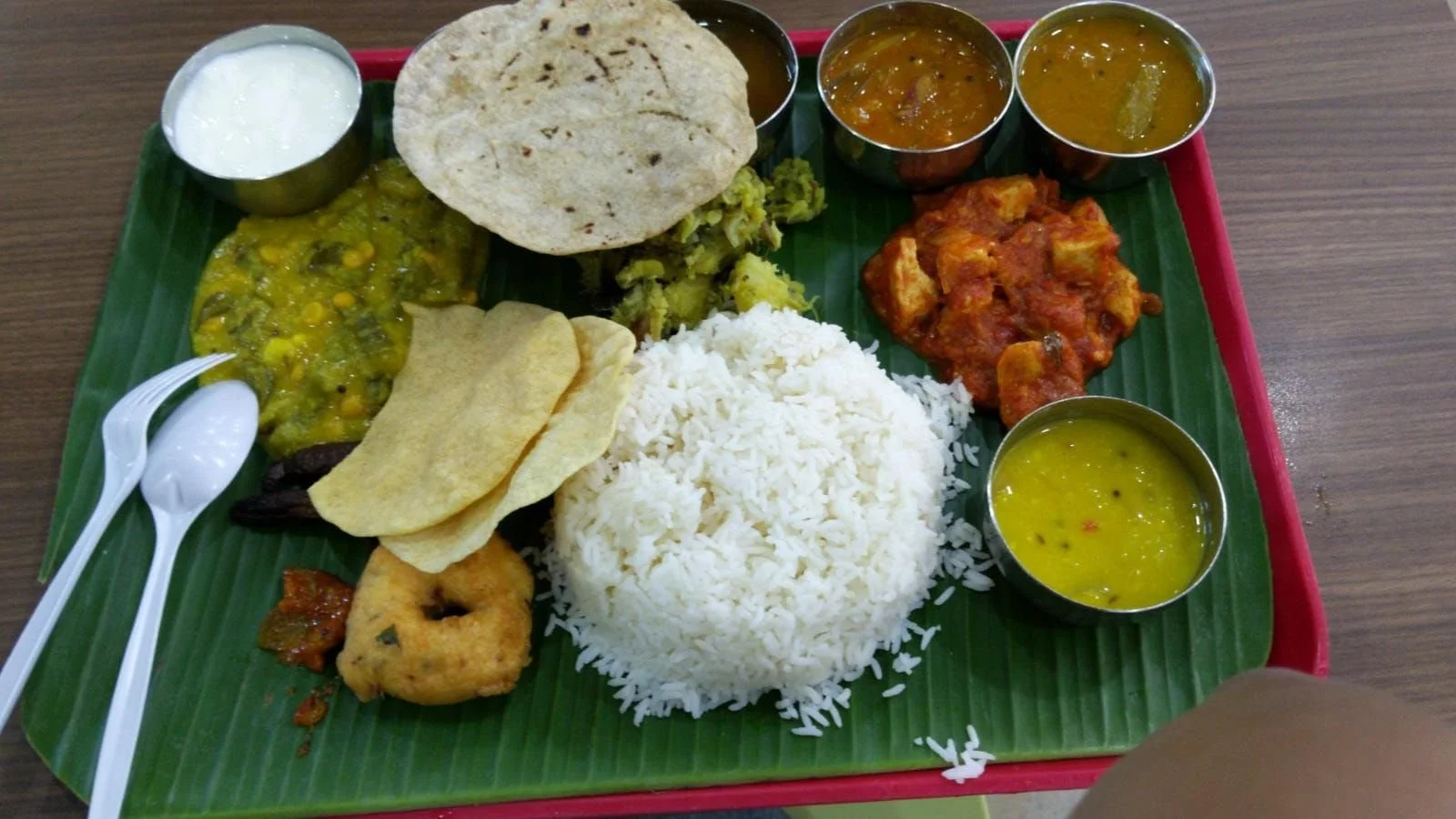
An all vegetarian feast to celebrate the author’s grandmother’s first death anniversary.
We eat and share stories about my grandmother. In each of these stories, there is a common refrain: ‘your grandmother would never let us leave the house hungry’.
I excuse myself and find a quiet corner to cry.
I feel grateful for being able to honour the lives of my family who came before me, who started their lives in a new land, who navigated the opportunities and challenges of modernisation, who did their best to keep the rituals of their forefathers while creating new traditions to pass down to their children and grandchildren.
I feel grateful to have lived with my grandmother and eaten from her hands meals that I desperately recreate as an adult, less obsessed with the way the meals taste than the feelings they inspire — of being nurtured and loved unconditionally.
I go back to the table and join my family.
In a few months, a few days before Deepavali, it will be time for the annual padayal again. The banana leaf will be laid. The food will be served. The relatives will gather. This time, instead of two pictures, there will be three. This time, my grandmother will be enjoying the padayal, reunited with her husband at last.
Arathi Devandran is a writer and columnist who explores the human condition and the nuanced experiences of South Asian women within a modern patriarchal world. Her work can be found here.
ALSO ON GOYA