How Caste is Branded as Taste in the Global Spice Aisle

In the spice aisles of his local halal grocery store in East of England, Jonah Batambuze finds that the masala boxes and brands reveal more about caste than any conversation. These boxes, specifically, do not talk about the hidden labour of the Dalit and Adivasi women whose hands have packed them.
When I first met Swetha at 21, she was the first South Asian person to speak with me beyond polite surfaces, meeting me with openness rather than distance. She told me she was Telugu. I said, “Tele-who?” Before I knew it I was practicing Nēnu ninnu premistunnanu — I love you — just enough to make her laugh, wince, and then laugh again. Love didn’t just give me new words. It brought me to the stove with questions in hand and eyes reset.
Cooking someone else’s cuisine is a love language in itself, which requires patience, improvisation, and memory. No matter how fluent you become at it, there will always be traces that you are not native. That was me at the stove, trying to perfect Swetha’s father’s keema recipe. I’d tasted his version in the plastic takeaway containers she brought back from home and tucked in a cupboard in the kitchen.
We hadn’t yet met, but through those meals I was already in a relationship with him. However carefully I measured my ingredients, it never matched his. Swetha would taste, smile, and with a squeeze of lemon or a sprinkle of salt, gently remind me: not quite.
In the beginning, Patak’s pastes were my training wheels. Each jar was a shortcut through a culture I was still learning to name. Eventually, I graduated to using powdered spices.
Cooking became an education — it was the start of trying to make sense of ingredients I hadn’t grown up with, in a kitchen where every label carried some history. Before I could read the footnotes on spice boxes, and on tin cans, I followed recipes to the letter. Years later, I still cook, but now with andaz.
“I can't eat that. I’m Brahmin.”
“I don’t do a, b, c, or d — because I’m Brahmin.”
These weren’t things Swetha ever said. They were comments I heard again and again in the community. They would arrive without context, but were heavy with meaning, and often times offered within minutes of meeting someone. They often left me disoriented, and unsure about whether I was being tested or excluded.
Swetha rarely said much when caste came up, but I could see something flicker in her eyes, like half-triggered muscle memory.
I probably wouldn’t know much about caste if I hadn’t married a South Indian woman. I was raised in a Midwestern town where my Ugandan parents sought refuge after fleeing Idi Amin’s regime in 1975. It was a place that never bothered to learn how to pronounce our names.
So when I began hearing “I’m Brahmin” slip into diaspora conversations, I noticed. There was no explanation, but the phrase was dropped like a marker. You could feel the weight of the word even if you didn’t yet know its roots.
At some point, I started reading: boxes, brands, and the ideologies they carried. Pretty soon, the spice aisle itself began to reveal more about caste than any conversation hitherto ever had. Somewhere between the rainbow of masala packets in my local halal grocery in the Fens in the east of England, something stopped me cold. The brand was Kitchen Treasures’ “Brahmin Sambar Powder.” The boldest word here wasn’t Kitchen or Treasure, but Brahmin.
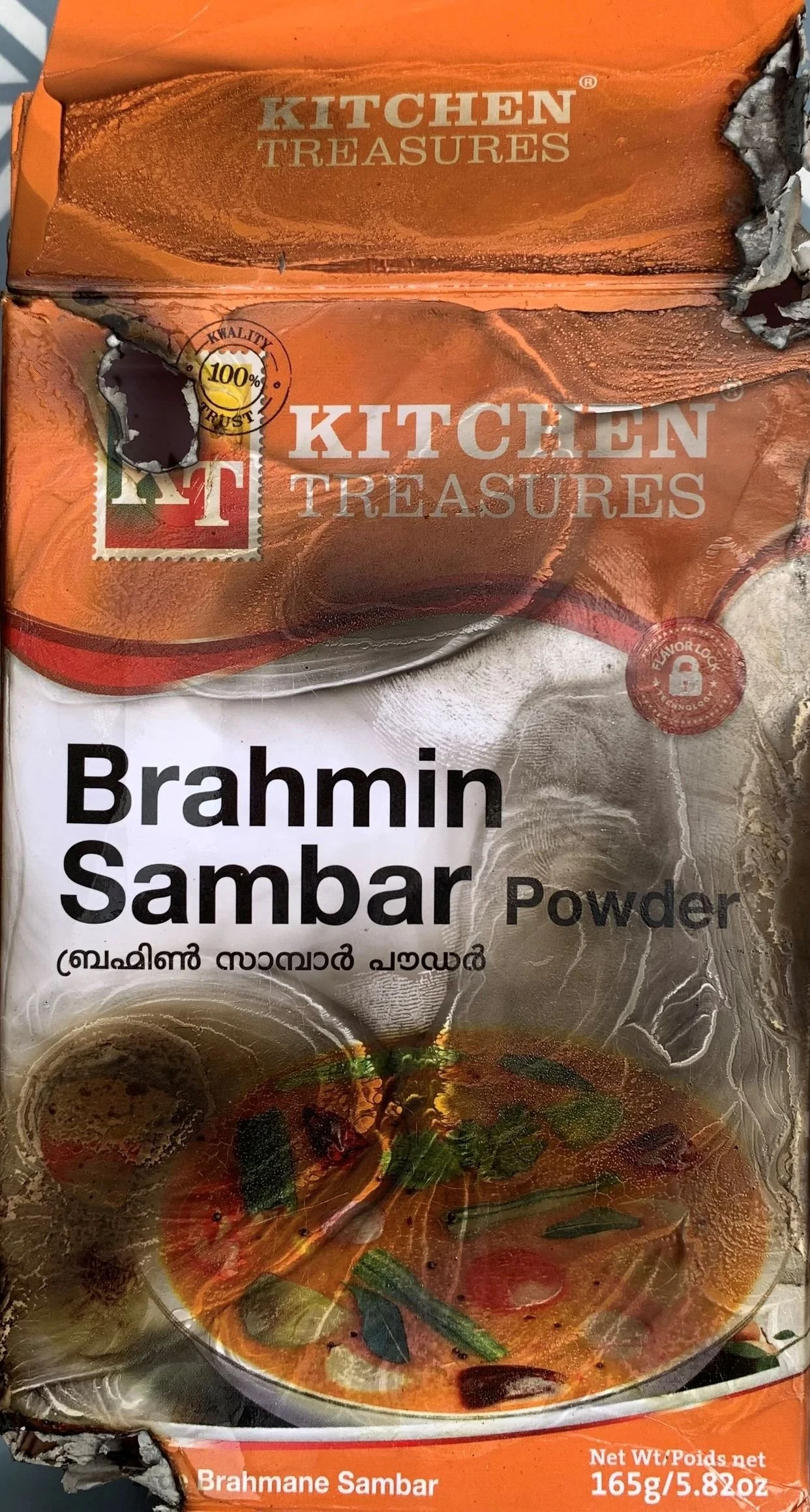
I froze, caught in a lockdown flashback: a Clubhouse conversation where a man insisted caste didn’t exist in the West. It was as absurd as claiming racism doesn’t either.

Then I saw another box, its font resembling a temple script, which read: Brahmins. This one didn’t just sell a caste. It was named after it. What happens when godliness turns into branding? When caste isn’t denied, but shelved next to cumin and coriander?
The packaging was never just about flavour. The serif fonts tried to mimick royal emblems, the Sanskritized scripts spoke about temple legitimacy, and the ivory and gold palettes seemed to cue some ancient ritual. Rajah didn’t just promise great flavours but, sovereignty.
“Brahminism doesn’t need to shout anymore,” Ajantha Subramanian reminds us. “It whispers.”
Nearly 5,000 miles from the spice hubs of Kerala and the chilli markets of Guntur, where these masalas originate, the last thing we see are the Dalit and Adivasi women whose labour is responsible for these boxes. Their callused, turmeric-streaked, hardworking hands don’t appear on the boxes, and their names are absent from all the hype about turmeric-lattes.
But, imagine for a moment: What if their fingerprints came sealed under the freshness tab, or if the aisle carried the sounds of their songs… would the branding still feel sacred? The further you get from the source, the purer the packaging becomes.
This isn’t new. In temple kitchens, Dalit and Adivasi women cooked, but never served so while their food was served to the divine, their presence was forbidden.
Now, centuries later, we trade in sealed pouches stamped with ISO-certified purity that is blessed, priced, and stripped of the dignity and identity of the hands that made them. The myth that Brahmin = vegetarian = pure = authentic has been strategically maintained through packaging and culinary gatekeeping. Taste here isn’t just about flavour. Taste here is what gets framed as refined, clean, desirable. Vegetarianism becomes a proxy for virtue, while those who cook or consume meat are cast as impure, lesser, even threatening to the social order.
As Anand Teltumbde reminds us, caste doesn’t need a whip. Sometimes, it just needs a menu.
It is food that decides who can touch the fire, who plates the meal, and who’s left waiting.
In the diaspora, caste isn’t just carried in lunchboxes, resumes, and spice tins — it is denied. That denial is beginning to fracture. Seattle has passed explicit caste discrimination protections, and in California a statewide bill passed the legislature in 2023 before being vetoed by the governor. In New Jersey, a Hindu temple was exposed for keeping Dalit workers in bonded conditions, with similar abuses surfacing in the American South.
Treating caste purity as mere dietary preference conceals the structural violence it enables. What gets moralised on the plate gets normalised in contracts, in kitchens, and in policy. Some will wonder why I don’t “stay in my box.” Why is a Black man is writing about caste? Why am I in the spice aisle, in the archive, in the kitchen? But there is no box big enough to contain the weight of our entangled oppressions, or our collective liberation. Black thinkers like Ava DuVernay and Isabel Wilkerson have long traced the lines between caste and anti-Blackness, showing it isn’t just a South Asian problem but a global structure living in colourism, class, policing, migration, and more. Naming caste here isn’t stepping outside my struggle. It’s walking deeper into it.
I met Swetha in 2001, while studying abroad in Dublin. Her childhood friend lived in my dorm, and that’s how our paths crossed. I’ve been tweaking this keema recipe for over twenty years.
Food travels in our communities as a love language — pickles, podis, tiffins, takeaway boxes. These are all ways of saying: ‘I remember you’ or ‘I made this for you’.
My father-in-law has always scoffed at my attempts at keema. The other day, when my in-laws returned from a trip to India, I left a container in the fridge. The next morning he messaged: “It wasn’t bad.” High praise in father-in-law dialect.
Swetha says my keema is almost like her father’s. And maybe that’s the point. The recipe is still changing. So am I. Still seasoning, still unlearning.
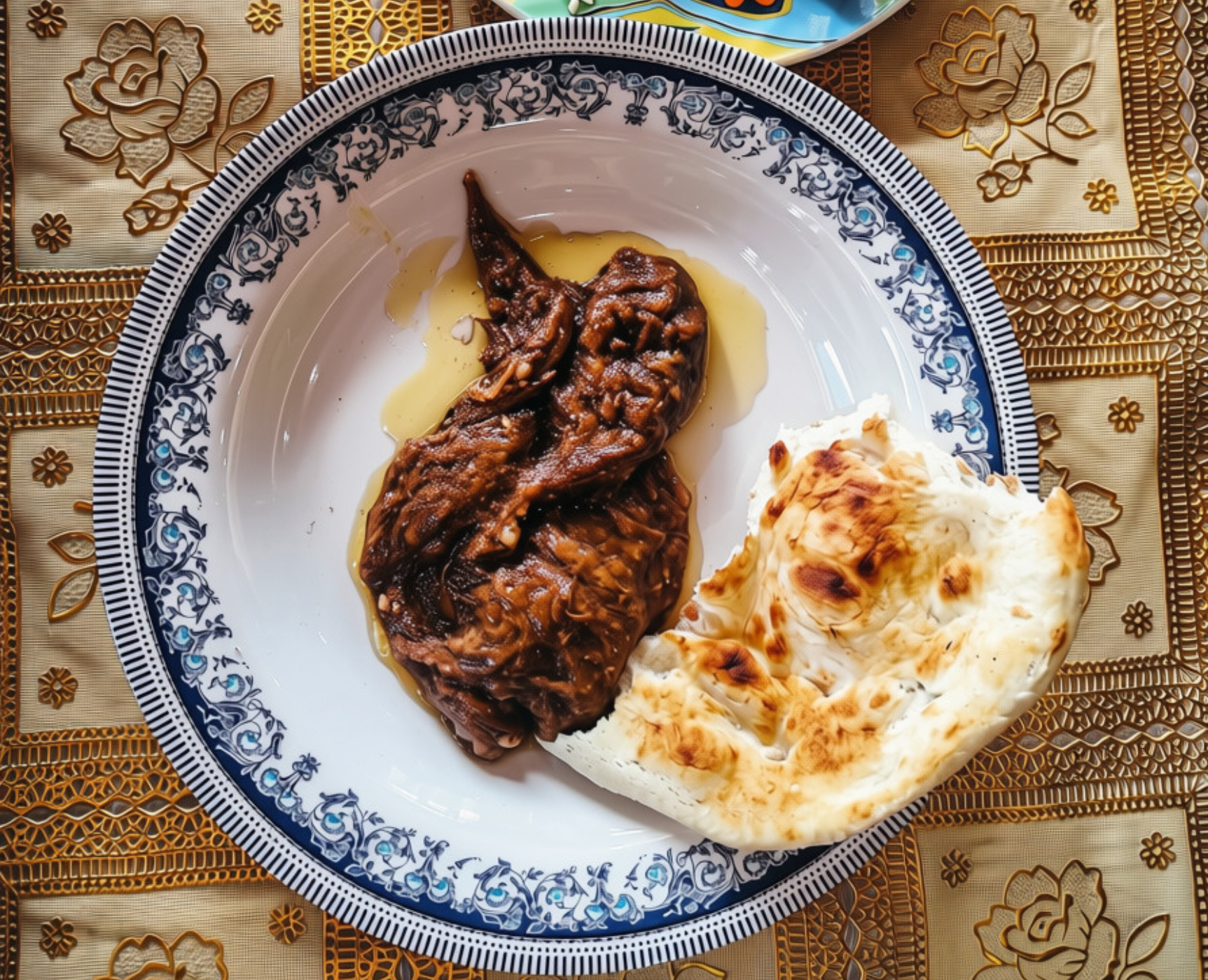
This is a family recipe that began at the stove and became a meditation on caste, care, and inheritance. It is a nod to Manu, my father-in-law, the man, the legend.
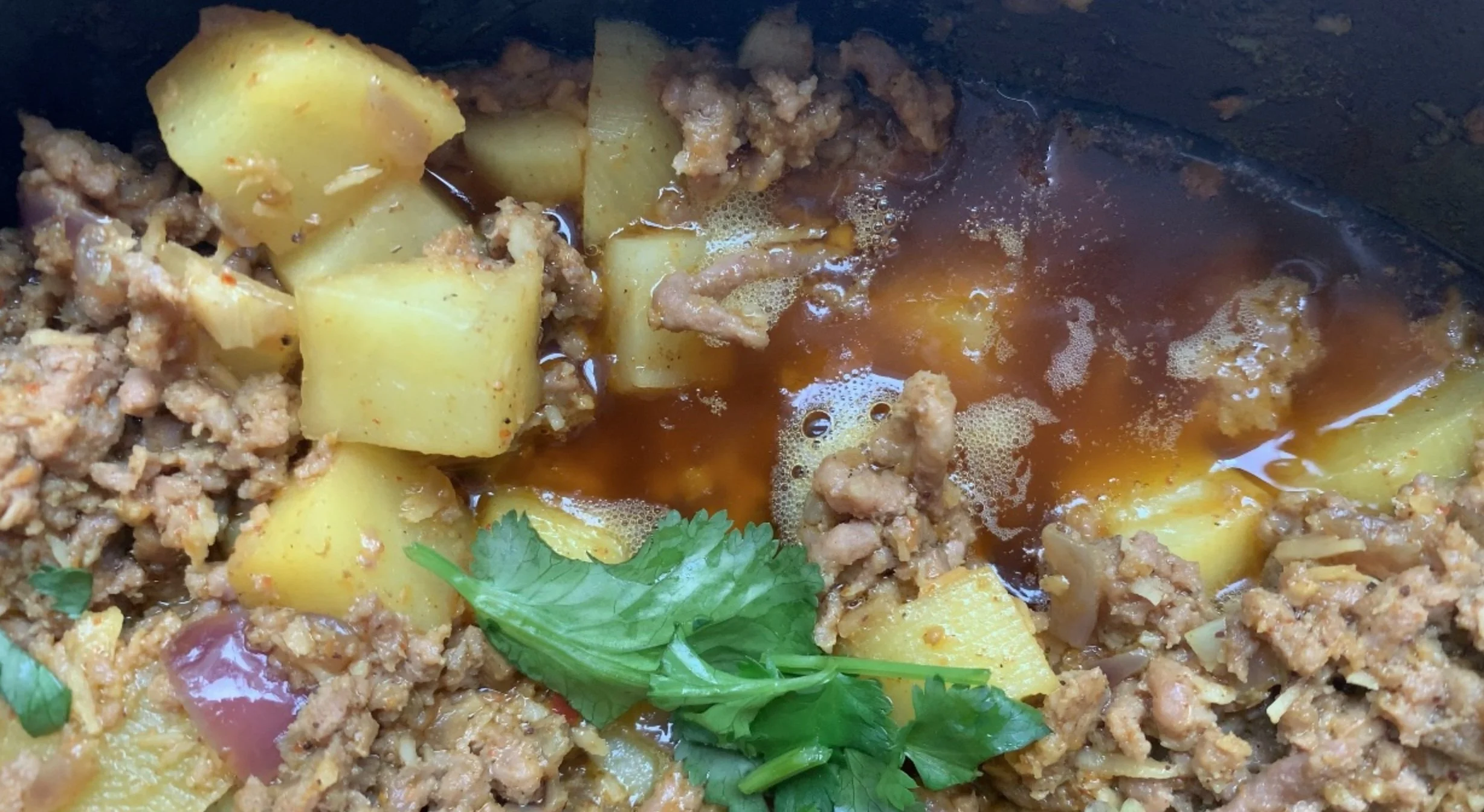
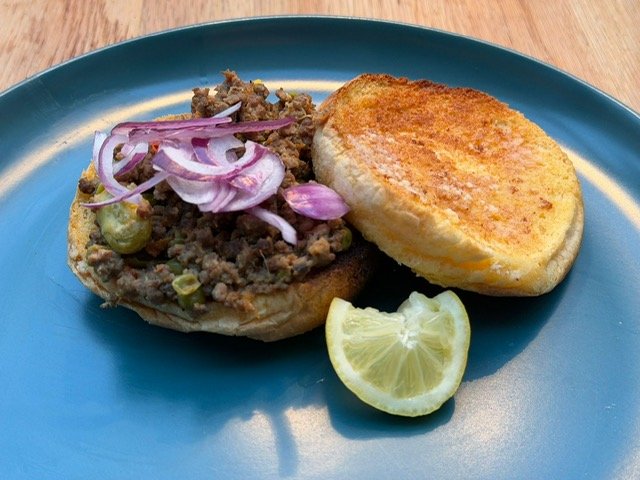
RECIPE FOR KEEMA ACCORDING TO MANU (ALMOST)
Serves 6
Ingredients
1 kg minced lamb or chicken
2 tbsp vegetable oil or ghee
2 large red onions, finely chopped
5 cloves garlic, minced
1-inch piece ginger, grated
⅓ packet keema masala mix (Shan or Laziza Int.)
1 green chili, slit lengthwise
Salt to taste
Juice of half a lemon
Fresh coriander leaves, chopped (for garnish)
Method
Heat oil or ghee in a pan over medium heat.
Add onions, garlic, and ginger. Sauté until golden brown and aromatic.
Add the green chili and the keema masala mix. Stir for a minute or two until the oil begins to separate and the spices bloom.
Add the minced meat, breaking it apart as it browns.
Add a splash of water midway to retain juiciness, if needed.
Cook for 20–25 minutes until the meat is tender and fully cooked through.
Finish with lemon juice and chopped coriander.
Serve with basmati rice, roti, or pav.
Jonah Batambuze is a Ugandan-American artist and cultural architect reimagining solidarity through food and ritual. He convenes the Left Hand Supper Club — a dining series born from refusal and remembrance, where you can taste Keema According to Manu (Almost) if you’re lucky.
ALSO ON GOYA